
From Corporate Climb to Saffron Fields: The Transformative Professional Journey of Ramesh Gera
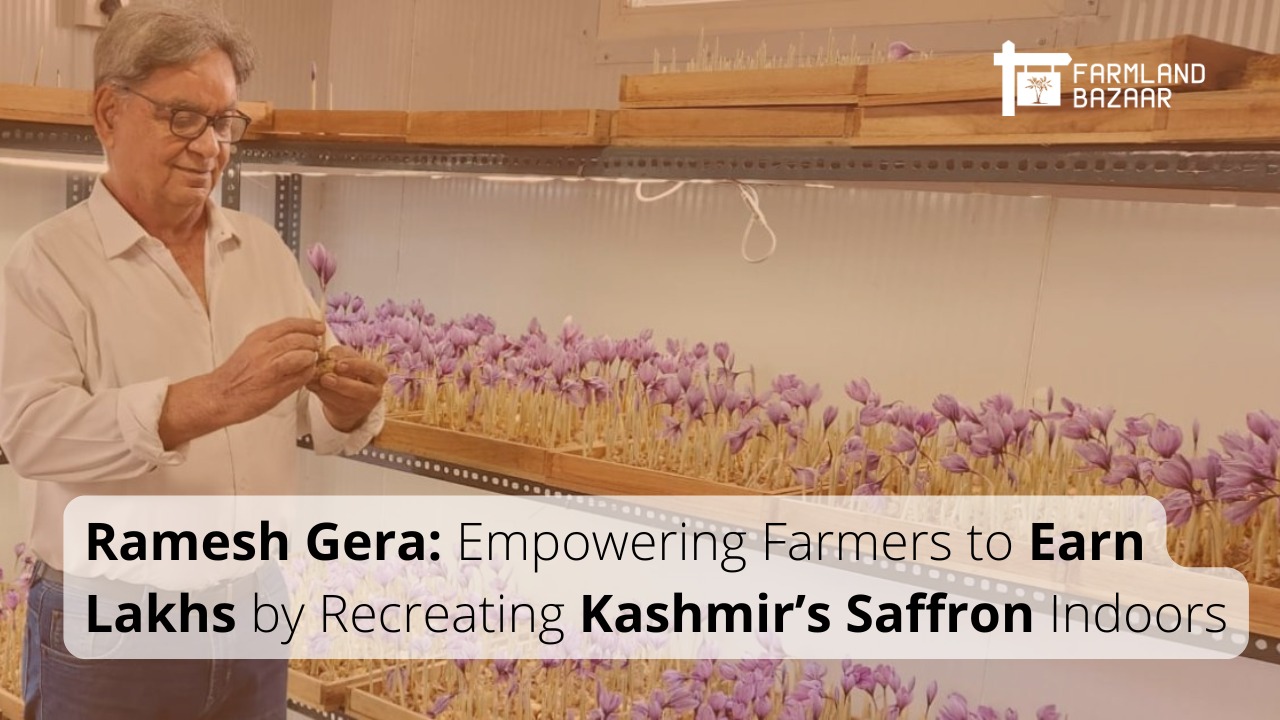
Imagine giving up a high-paying corporate job, one that offers international travel, financial security, and a prestigious title—only to return to your roots and start all over again. For Ramesh Gera, this wasn't just a bold decision but one driven by an unshakable curiosity: Why were Indian farmers, including his own family, barely making a living despite years of toil? His father once told him, “Farming has no potential. I’ve done this my whole life and can barely pay your school fees.”
This conversation deeply impacted Ramesh, sparking a lifelong curiosity about why hardworking farmers struggled to earn a sustainable income.
Born into a farming family in Haryana, Ramesh had long questioned the struggles of farmers. However, like many, he chose a more conventional path—pursuing engineering and securing a lucrative job at a multinational corporation. But even as he traveled across the world, meeting farmers in the U.S., South Africa and beyond, that nagging question from his childhood refused to fade. It wasn’t until a personal tragedy struck that Ramesh decided to answer the call he'd been avoiding for years.
What led Ramesh to walk away from his comfortable corporate life? And why did he choose saffron farming as the key to revolutionizing Indian agriculture? This is the story of a man who left behind everything he had built to follow a dream that had been quietly growing for decades.
Engineering Success, but a Persistent Curiosity About Farming
Fulfilling his father’s dream, Ramesh pursued a degree in engineering and secured a high-paying job with a multinational corporation (MNC). His corporate career took him around the world, allowing him to witness farming practices in countries like the United States and South Africa. What struck him during his travels was the advanced agricultural technology in these countries, enabling farmers to lead prosperous lives. In contrast, Indian farmers, who used outdated methods and lacked proper resources, were struggling.
Despite his successful engineering career, Ramesh remained curious about the disparities in farming systems. He resolved to bridge this gap and bring advanced technology to Indian agriculture, so farmers could benefit just like their international counterparts.
A Life-Changing Decision: From MNC to Farmer
In 2016, a personal tragedy turned Ramesh’s life in a new direction. While renewing his visa to return to his corporate job, his wife fell ill, and despite treatment, she passed away. This life-altering event pushed Ramesh to reconsider his career path, and he decided to stay in India to pursue his true passion—agriculture.
In 2017, at the age of 58, Ramesh launched Akarshak Hydroponics, named after his son Akarshak. The company, later rebranded as Akarshak Vertical Farms, focuses on training farmers and aspiring individuals in modern farming techniques, particularly hydroponics and other soil-less methods.
Akarshak Vertical Farms: A Technological Leap in Agriculture
Ramesh Gera’s fascination with modern agriculture led him to create Akarshak Vertical Farms, where cutting-edge techniques like hydroponics, microgreens cultivation, and indoor saffron farming became a reality. Starting with small experimental setups at home, Ramesh eventually scaled these systems for commercial use.
1. Hydroponics: Hydroponics is a method of growing plants without soil, where roots are immersed in nutrient-rich water, ensuring balanced nutrition, water, and oxygen for faster growth and higher yields. Akarshak Vertical Farms utilizes this closed-loop system to accelerate the growth cycle to 40 days instead of 3-4 months. This method allows for up to 9-10 annual harvests, reduces water usage by 90%, and eliminates soil-borne diseases. Key techniques include Nutrient Film Technique (NFT), Deep Water Culture (DWC), Aeroponics, and Aquaponics, making it ideal for efficient, soil-less farming.
2. Microgreens: These nutrient-dense young plants are harvested between 5-12 days and are grown indoors with minimal space and resources. Using vertical racks optimizes space, making it ideal for urban farmers.
3. Indoor Saffron Cultivation: By replicating Kashmir’s climate, saffron bulbs are cultivated in controlled environments for about 2.5 months. This method produces high-quality Mogra saffron, valued at ₹3-6 lakh per kilogram, offering significant commercial potential with an efficient growing cycle.
Empowering Indian Farmers: The Mission Behind Akarshak Vertical Farms
Despite the profitability of saffron and other high-value crops, Ramesh’s true passion lies in empowering Indian farmers. His multi-layer organic farming program is specifically designed for farmers, allowing them to grow multiple crops on a single piece of land, optimizing both space and resources. Traditional farming typically relies on one crop per acre, but Ramesh’s model enables farmers to grow 4-6 crops simultaneously using vertical farming methods.
The program, offered at a nominal fee to cover food and accommodation, aims to provide farmers with both knowledge and tools to increase their income while reducing environmental degradation.
Scaling the Movement: A Vision for the Future and A Farming Revolution
Since founding Akarshak Vertical Farms, Ramesh has trained over 1,200 individuals, many of whom are now successfully running their own agricultural enterprises. His business, built on the principles of Truth, Trust, and Transparency (3TR), operates with lean resources but delivers maximum impact. With an 80-90% profit margin, the startup generates between ₹5 and ₹8 lakh per month.
Ramesh’s next goal is to scale his operations even further. He plans to expand his team, introduce more farming techniques, and develop new trainers to help meet the growing demand for training. He aims to reach ₹10 lakh in monthly revenue by introducing 2-3 new courses in the coming months.
In addition to scaling his business, Ramesh is committed to conducting Monthly Deep Dive programs and Village Workshops aimed directly at farmers in Haryana and Punjab. These workshops will help raise awareness about sustainable farming techniques, offering practical solutions to farmers’ challenges.
Ramesh Gera’s journey from a high-powered engineer to a passionate advocate for modern farming is a story of transformation. Through Akarshak Vertical Farms, he is not only creating a sustainable business but also empowering farmers with the knowledge and tools to thrive. By integrating advanced technologies like hydroponics, vertical farming, and indoor cultivation, Ramesh is helping to revolutionize Indian agriculture—one farmer at a time. His vision is not just to make farming profitable, but also to create a movement that will enable farmers to harness the potential of modern techniques for a better future.
Written by Farmland Bazaar Team
Agricultural assets advisor contributing to Farmland Bazaar v2. Focusing on organic investments, soil analysis reports, and deed checks.