
What If Your Weekend Home Could Be a Farm?
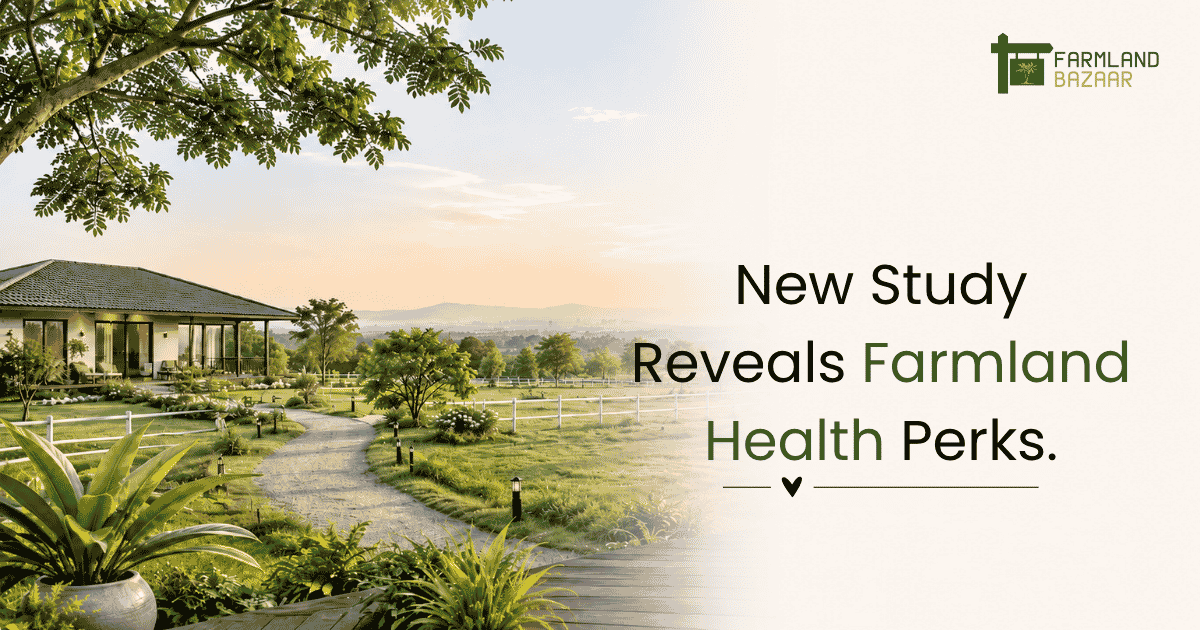
For a generation that spends most of its week inside offices, apartments, cars and schools, the idea of having a piece of land outside the city is beginning to look less like a luxury and more like a practical lifestyle choice.
A new international study has added an interesting dimension to that conversation.
Researchers from the University of Queensland, studying data from nearly 20,000 people in the UK Biobank who developed type 2 diabetes, found that people with greater exposure to private gardens had a 6.8% lower risk of developing type 2 diabetes. Those living near multiple public parks also showed a lower risk. The study was published in BMC Public Health.
The researchers do not claim that having a garden prevents diabetes. Instead, they point to several possible explanations for the association, including greater physical activity, exposure to sunlight and the mental health benefits of spending time outdoors.
But there is a bigger point here for India's increasingly urban families: what happens when access to nature becomes something you have to own?
The city gives us convenience. It is taking away space.
Consider a typical urban weekend.
A family spends Monday to Friday moving between home, school, office and traffic. Come Saturday, children may have a few hours of activities, parents may squeeze in a restaurant visit or a mall trip, and Sunday disappears before Monday arrives again.
There is nothing wrong with city life. In fact, cities provide opportunities, jobs, education, healthcare and connectivity that are difficult to replicate elsewhere, but there is a trade-off. As cities become denser, private outdoor space becomes harder to find, and a balcony garden may be the only greenery many apartment residents have direct access to.
The World Health Organization has consistently highlighted the role of green spaces in supporting physical activity, relaxation, mental wellbeing and healthier urban environments, and this matters particularly in India, where the burden of lifestyle-related diseases is already significant. The ICMR-INDIAB study estimated that India had around 101 million people with diabetes and 136 million with prediabetes.
The answer, of course, is not to move everyone out of cities, but perhaps there is another option.
You don't have to live on a farm every day
This is where the idea of farmland as a second home becomes interesting.
Imagine living in Bengaluru but owning a small farm plot a couple of hours away. The city remains your primary home. Your children's school and your office remain there too, but some weekends are different. You drive out, and there are trees instead of towers. Walking becomes part of the day rather than another item on the fitness app, children have space to run, and a family can sit outdoors, plant something, grow vegetables, cycle, read or simply spend time together without planning an activity around it.
It does not have to be an everyday lifestyle. It can be a weekend lifestyle, and that may be a more realistic proposition for India's urban middle and upper-middle-class families.
This is also where the idea of managed farmland changes the equation. Owning agricultural land used to come with the assumption that someone from the family had to be around to look after it, arrange water and labour, and keep the plantation going through the week. Managed farmland projects take that responsibility off the owner's plate. A professional team handles cultivation, maintenance and upkeep through the week, so the family's role is simply to show up on the weekends they choose and enjoy the land, not run it. That is what makes the second-home-on-a-farm idea workable for someone who still has a full-time job and a life in the city.
From a weekend escape to a family asset
There is another reason farmland ownership deserves a closer look. Unlike a resort booking or a holiday home rental, ownership creates permanence. You are not simply paying for an experience for one weekend. You are acquiring an asset that, subject to location, title, approvals, land-use rules and market conditions, can remain within the family, and that changes the conversation.
Today, the land may be a place where parents spend their weekends. In ten years, it could be where their children bring friends, in twenty years it could become a family gathering place, and eventually it could become an asset passed to the next generation. This is why farmland can be viewed through two lenses at the same time: lifestyle and legacy.
The investment case will always depend on the fundamentals of the land and project, and appreciation is never guaranteed simply because something is farmland. But the lifestyle value is more immediate, since you can use it while you own it.
The next generation may value the space differently
There is also something increasingly valuable that does not appear on a property brochure: childhood experiences.
Children growing up in cities can spend hours surrounded by screens, structured activities and traffic. A farm offers a different environment.
They can see where food grows, understand seasons, plant a tree and watch it change, and spend a morning outdoors without being told that it is time to go home because the park is closing.
That does not make farmland a substitute for a city home. It simply gives families access to something the city cannot always provide at scale: space and proximity to nature.
The WHO and UNICEF, in a 2026 guide on child-friendly public spaces, noted that only 44% of urban residents globally live near an open public space, with the figure falling to 30% in low- and middle-income countries. The organisations also highlighted the importance of safe opportunities for children to move, play and engage with nature.
That makes private or community-accessible green spaces increasingly relevant.
But don't buy the idea. Buy the land carefully.
This is where the farmland conversation needs to remain grounded. Greenery alone does not make a project a good purchase.
Before buying, buyers need to examine title and ownership records, land-use permissions, approvals, access roads, water availability, development restrictions, maintenance arrangements and the developer's track record. The distance from the city matters too. A farm that is so far away that the family visits twice a year may not deliver the lifestyle value it was purchased for, and for a weekend-use proposition, accessibility is part of the value proposition.
The best fit is therefore not necessarily the largest plot or the greenest brochure, but land that works for the family's actual life.
The real win-win
The interesting thing about farmland ownership is that its value does not have to be reduced to a single number. There is the potential long-term value of the land, the utility of having a private or community green space, the opportunity to spend more time outdoors, the possibility of creating family memories, and the potential to leave something tangible behind for the next generation.
The recent University of Queensland study does not prove that owning farmland will make anyone healthier. It does, however, add to the broader evidence that access to green environments matters for human health and wellbeing, which makes the question worth asking: if your family spends five days a week in the city, why shouldn't the other two be spent closer to nature?
For many urban families, farmland may not be about escaping city life. It could be about balancing it, a home in the city for today, a piece of land outside it for the weekends, and an asset that, if chosen carefully, could remain part of the family long after the weekend is over.
Written by Farmland Bazaar Team
Agricultural assets advisor contributing to Farmland Bazaar v2. Focusing on organic investments, soil analysis reports, and deed checks.