
Forest vs Fortune: How 400 Acres at University of Hyderabad Sparked a National Showdown
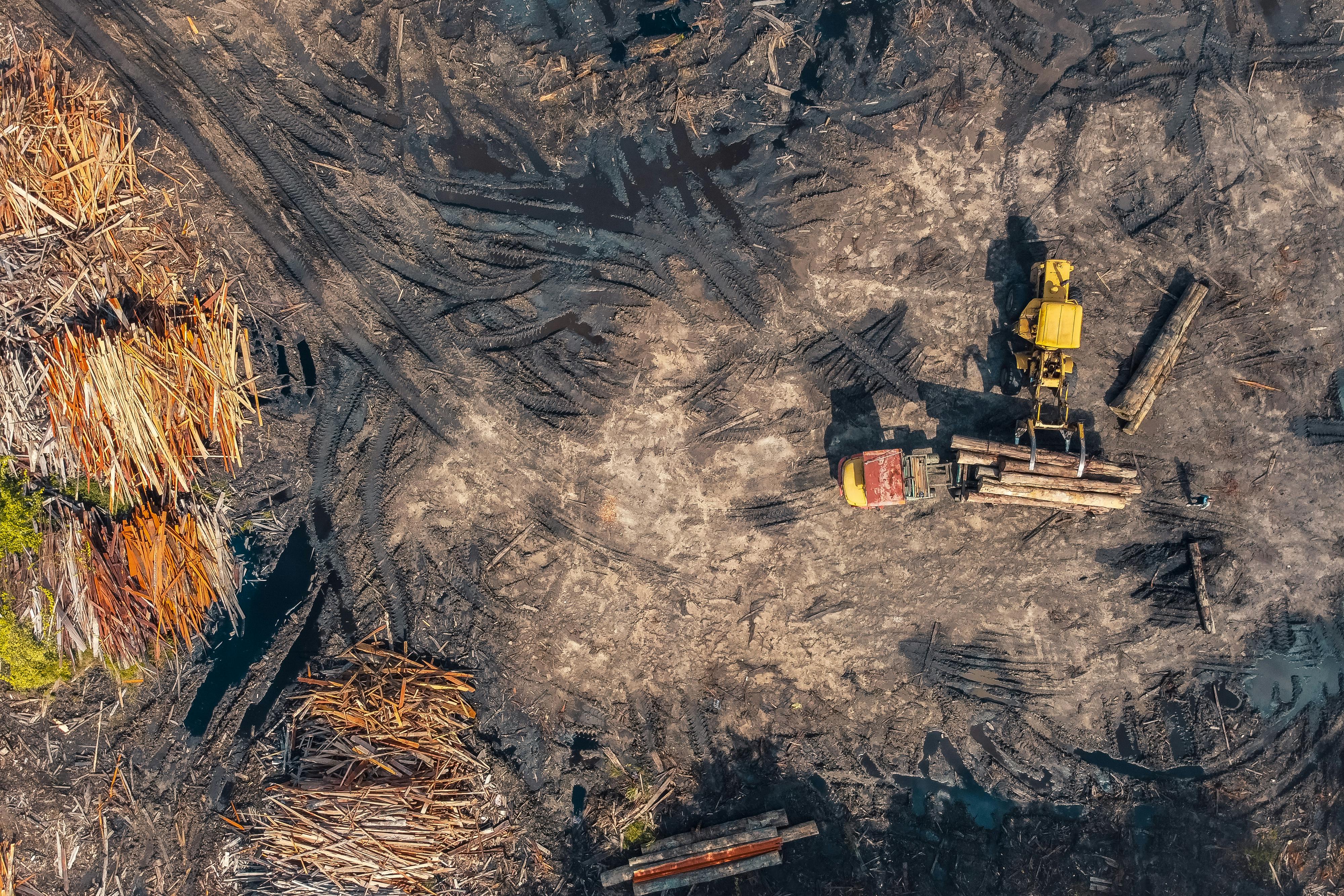
Hyderabad | April 5, 2025 — A forest patch at the heart of Hyderabad’s expanding urban jungle has turned into a battlefield of ideologies, legality, and environmental concern. What began as a government initiative to auction 400 acres of land for IT development has morphed into a massive student-led environmental movement, drawing nationwide attention and judicial intervention at the highest level.
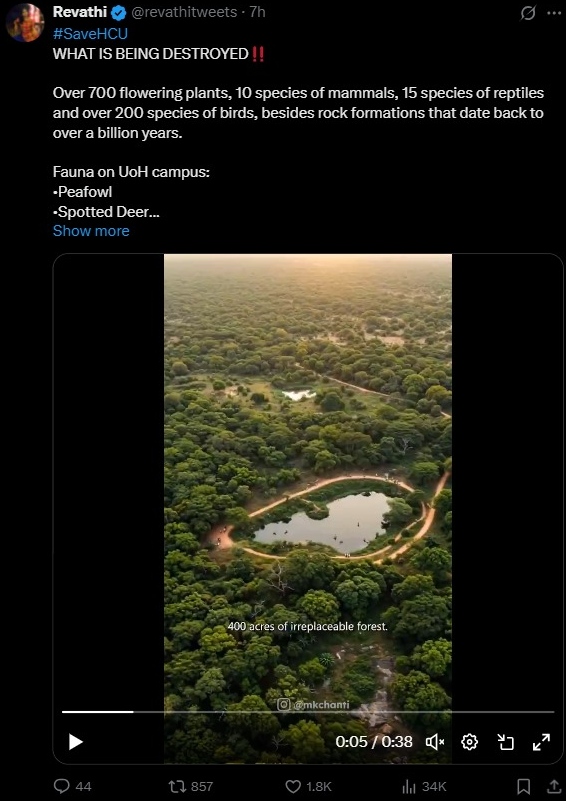
The Land in Question: Legal Ownership vs Moral Custodianship
The disputed 400-acre parcel lies within the 2,324-acre campus of the University of Hyderabad (UoH), also known as Hyderabad Central University. Though allotted by the undivided Andhra Pradesh government in 1975 for academic use, the land was never formally registered in the university’s name.
The government order issued in 1975 stated: “The land should be used for the purposes allotted. The land will revert to the State government if it is used for other purposes not directly connected with education or technology without prior written permission.”
However, in government records, the land remains listed as “Kancha Asthabal Poramboke Sarkari”—grazing and wasteland, legally under the state’s ownership. Yet, the university functioned as its de facto custodian, developing academic buildings, boundary walls, and green belts.
Eyes on the Land: When Development Pressures Escalated
As Gachibowli’s real estate market soared, successive governments began viewing UoH’s vast landholdings as potential economic assets. A retired official recalls that a committee of secretaries questioned the need for over 2,300 acres for academic purposes, urging the university to consider vertical expansion that would require no more than 100 acres.
In response to growing pressure, then Vice-Chancellor Ramakrishna Ramaswamy made repeated efforts to get the land registered, including personal visits to the Secretariat. Despite his persistence, registration was never completed.
Historical Timeline: From Promise to Protest
1975: Undivided Andhra Pradesh allots 2,324.05 acres to UoH for academic purposes.
2003: Then CM Chandrababu Naidu enters into an agreement with IMG Bharata, allotting 400 acres from the UoH campus for sports infrastructure and an additional 450 acres at Mamidipalli. In return, UoH is given 397.16 acres in Gopanpally.
2006: The agreement is cancelled by the Y.S. Rajasekhara Reddy-led Congress government. A legal battle ensues.
2007–2023: Supreme Court case over land ownership. In 2023, court rules in favour of the Telangana government as the legal owner.
2004: Telangana Forest Department inspects alleged encroachment on nearby land by a private trust constructing Sri Anjaneya Fort. Notices are issued for land clearing and unauthorized construction.
Feb 2025: Telangana government announces plans to auction 400 acres of forest-adjacent land for IT parks. Projected investments: ₹50,000 crore; Jobs: 5 lakh.
March 2025: Protests erupt. Students highlight the ecological importance of the area, including its Mushroom Rock formation.
March 30, 2025: Over 50 bulldozers enter campus; tree felling begins on the East Campus.
March 31–April 2, 2025: Student-police clashes escalate. 53 detained, 2 arrested. UoH Students’ Union launches indefinite strike.
April 3, 2025: Telangana High Court halts deforestation.
April 4, 2025: Supreme Court takes suo motu cognisance, stays land clearing, demands a Central Empowered Committee (CEC) report by April 16. Chief Minister Revanth Reddy forms a ministerial committee to find a resolution. A three-member Group of Ministers meets with civil society, students, and professors. Professors argue that true development must respect environmental legacy.
What Makes Kancha Gachibowli Special?
Known as Hyderabad’s last urban forest, Kancha Gachibowli plays a vital ecological role:
-
Carbon sink in a high-pollution zone
-
Home to Schedule-I wildlife and native flora
-
Part of the Osmania University forest corridor
-
Features rare granite rock formations, including the famous Mushroom Rock
“Urban forests are not empty land—they are living infrastructure,” said Dr. Veena Iyer, ecologist and UoH alumna.
The Fort in the Forest: Sri Anjaneya Controversy
In recent years, a private spiritual trust began building a massive Sri Anjaneya Fort on the outskirts of the university forest zone.
-
Land use: Massive levelling and stone construction altered the natural terrain.
-
Forest Department Action: Issued notices citing encroachment, illegal tree clearing, and unauthorized use of reserve forest area.
-
Trust's Defense: Claimed the land was patta land (privately owned) and not officially declared forest; produced documents and deeds dating back several decades.
Shrinking Campus: What’s Left?
Of the original 2,324 acres:
-
812.13 acres have been allotted to 20+ external institutions.
-
105 acres: Water bodies (4 lakes)
-
400 acres: Rocky terrain
-
255 acres: Green buffer (biodiversity)
-
200 acres: High-tension lines
-
65 acres: Roads and pathways
Total unbuildable: 1,025 acres
Effectively usable: ~487 acres (after allocations and deductions)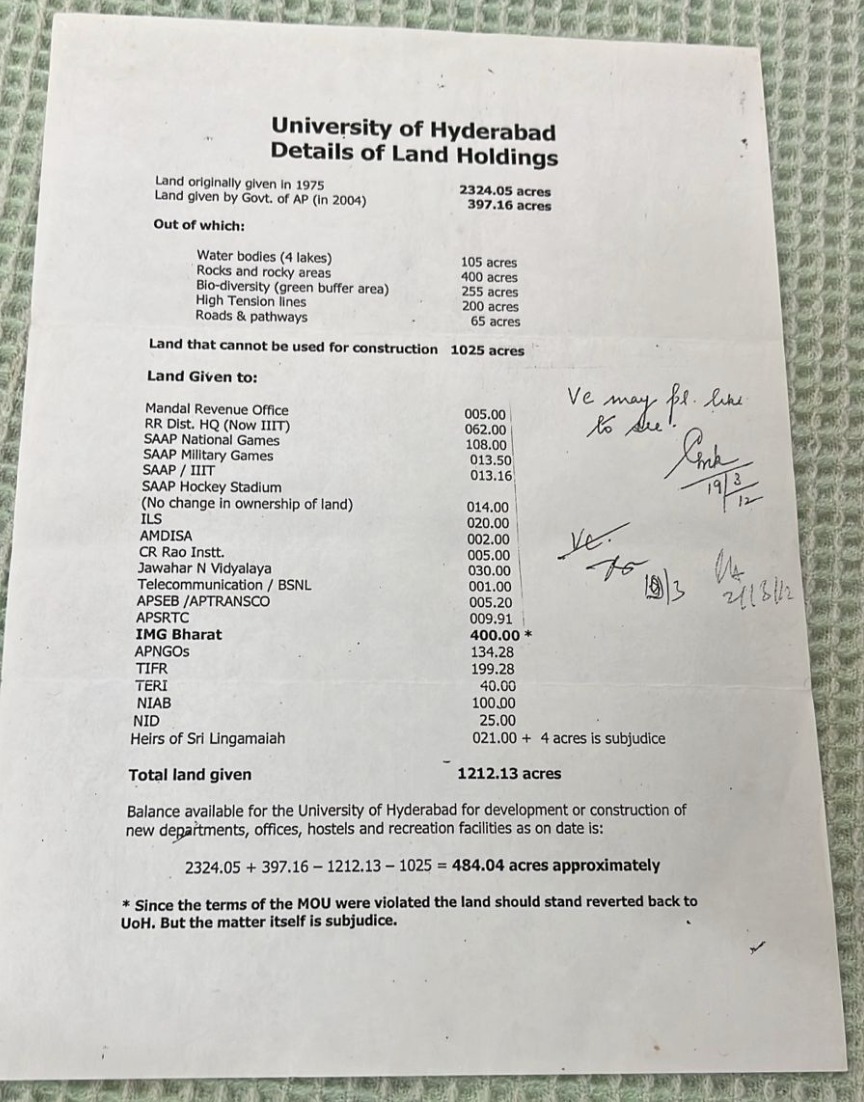
Notable allocations:
-
62 acres to Ranga Reddy District Collectorate
-
40 acres to Indian School of Business
-
20 acres to National Institute of Animal Biotechnology
Who Needs the Land More? A Struggle Between Progress and Preservation at UoH
In the simmering debate over land allocation on the University of Hyderabad (UoH) campus, a deeper question lingers: What does development truly mean—and at what cost?
At a meeting with state ministers on April 1, noted academic and former UoH professor, Prof. G. Haragopal challenged the prevailing narrative. “The government speaks of investments and job creation, but is that the only definition of development?” he asked. “There are ecological and academic priorities that can’t be dismissed.” Referring to official remarks about the campus' “bush growth” being a result of neglect, he clarified, “That’s not neglect—that’s how forests evolve naturally over time.”
The university itself has roots far deeper than most know. Born from the 32nd Constitutional Amendment under the Six-Point Formula, UoH was established to ease tensions following the Telangana agitation in the late 1960s. It is among India’s rare educational institutions born from a constitutional mandate, intended to serve the entirety of undivided Andhra Pradesh. “When the first Vice-Chancellor Gurbux Singh built the compound wall, it wasn’t just concrete—it marked our constitutional and territorial identity,” said student union president Umesh Ambedkar. “That wall, over the years, has been broken—physically and symbolically.”
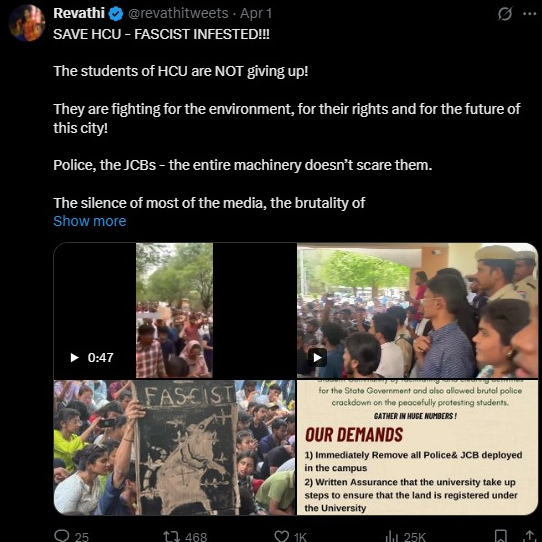
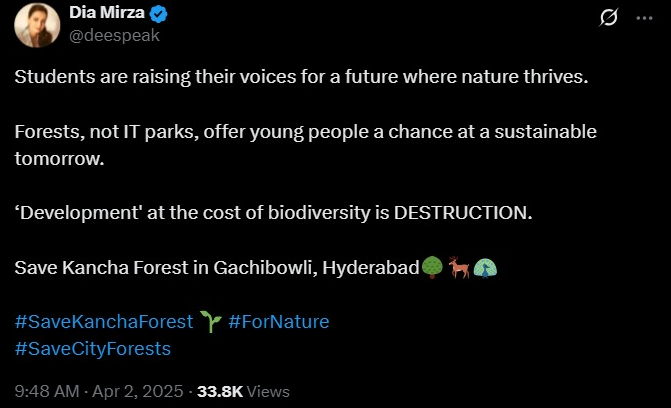
Student voices have grown louder as bulldozers edge closer. “This isn’t just about cutting trees—it’s about erasing an academic legacy,” said protest leader and PhD scholar Vineela Raj. “We are fighting for the soul of our campus, not just its soil.”
Government’s View: Growth and Green Can Coexist
The state government, however, insists that progress doesn’t have to mean destruction. A senior official from the Telangana State Industrial Infrastructure Corporation (TGIIC) stated, “We are not destroying. We are developing responsibly. Rock formations will be preserved, and green spaces will be retained.” But critics remain unconvinced. No Environmental Impact Assessment (EIA) has been made public so far—an omission many say flouts key norms under the Environmental Protection Act.
As bulldozers loom and slogans echo across the rocky terrain, the question remains: who needs this land more—those who dream of industrial corridors, or those safeguarding an ecosystem and an academic ideal decades in the making?
Watch here, how buldozers raze through the forests: https://youtu.be/QD3fbcvCarY
What Happens Now?
With the Supreme Court’s stay in place and the Central Empowered Committee’s report due on April 16, the fate of Kancha Gachibowli hangs in balance.
Will it remain a forest or transform into Hyderabad’s next IT corridor?
The answer lies not just in courtrooms or committee meetings, but in how India chooses to define “development” in an era of climate urgency.
Written by Farmland Bazaar Team
Agricultural assets advisor contributing to Farmland Bazaar v2. Focusing on organic investments, soil analysis reports, and deed checks.