
From ₹60,000 to ₹25 Crore: How India’s Farmland is Quietly Becoming the Smartest Long-Term Bet
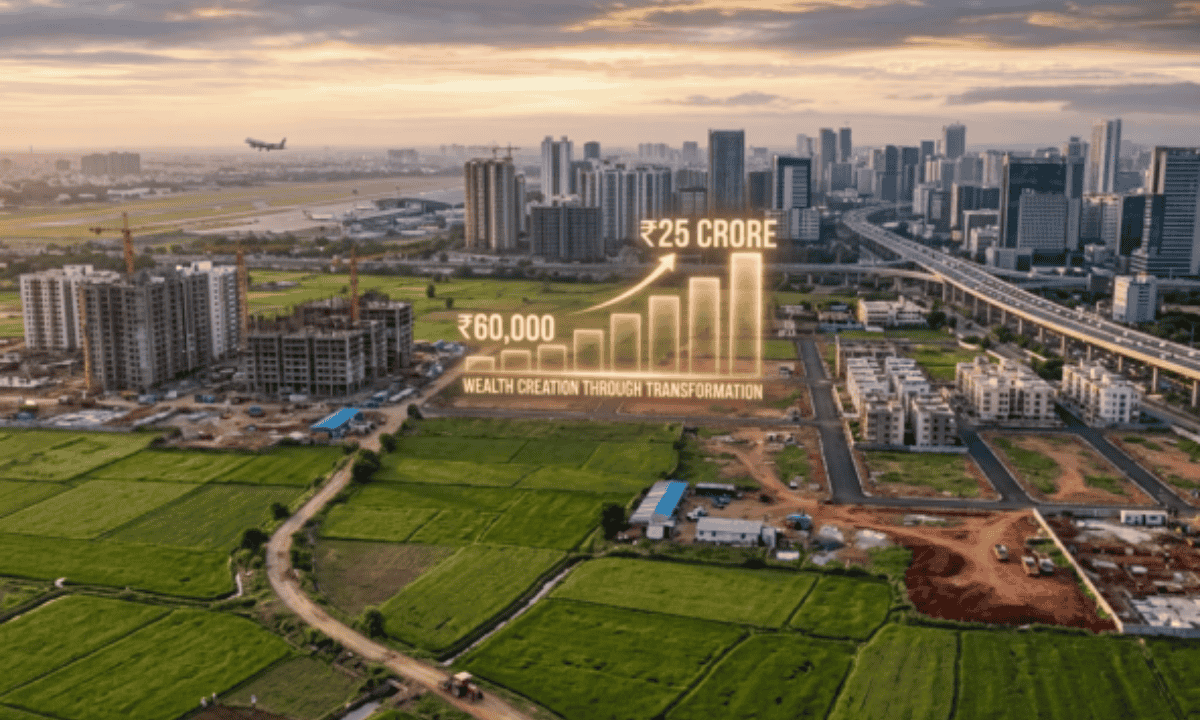
A few days ago, a simple story started doing the rounds online. No flashy charts, no complicated jargon; just a man talking about how his uncle had bought a piece of farmland decades ago for ₹60,000. Back then, it was on the edge of a quiet town, with little more than open fields and a distant road. Over the years, the town grew, roads improved, businesses moved in and recently, a part of that same land was sold for ₹25 crore.
What struck people wasn’t just the return. It was the realization that this wasn’t a one-off story.
Across India, similar narratives are quietly surfacing, where farmlands were once bought in completely overlooked locations, often dismissed as too far, too quiet, or simply “nowhere.” Back then, these areas were defined by isolation, with long stretches of empty roads, minimal infrastructure, and little to no economic activity.
Today, that same land is sitting at the edge of expanding cities, new highways, and emerging economic zones. What was once considered desolate and silent is now becoming some of the most strategically connected and planned growth corridors, with access, infrastructure and development steadily catching up.
And these are outcomes of a larger, structural shift: India is urbanizing rapidly, and the land surrounding today’s cities is slowly becoming tomorrow’s real estate hotspots.
Data backs this shift. According to Knight Frank, infrastructure-led development, particularly new airports, expressways and industrial corridors has become one of the biggest drivers of land value appreciation in India. Meanwhile, advisory firm ANAROCK has repeatedly pointed out the growing investor interest in peripheral land parcels, especially those lying in the path of future urban expansion.
Take the impact of large infrastructure projects. The upcoming Noida International Airport, for instance, has already triggered sharp land price movements in surrounding regions, well before its completion. Similarly, expressway corridors and logistics hubs are quietly redrawing the investment map across multiple states.
What’s changing now is the mindset. For years, farmland was seen as a passive, even uncertain asset, useful for agriculture, but not necessarily for wealth creation. Today, a new class of investors is beginning to see it differently: as a long-term play on where the next city will grow. And unlike apartments, where value is often capped by supply and rental dynamics, farmland carries a different kind of potential, one that unfolds slowly, but can be transformative when it does.
Lets understand the detailed trend.
The "Jackpot" Phenomenon: Real-Life Transitions
The buzz gained momentum with a viral post from a stock trader who shared how his uncle had purchased four acres of land in a small town decades ago for just ₹60,000. At the time, the area lacked basic infrastructure and investor interest. Over the years, as urban sprawl transformed the town into a district headquarters, the land’s strategic relevance changed entirely. Eventually, two acres of that plot were sold to retail giant DMart for ₹25 crore; turning a quiet, forgotten investment into a generational windfall.
A similar pattern is visible in the Delhi-NCR belt. A family that had acquired 3 bighas of land in Noida for ₹6 lakh saw its value climb to over ₹5 crore. This wasn’t just organic appreciation; it was a combination of government compensation, rezoning benefits, and timely reinvestment near the upcoming Noida International Airport. As infrastructure took shape, the land’s utility and therefore its valuation shifted dramatically.
These are not isolated incidents anymore. Across India, from tier-2 cities to the outskirts of major metros, similar stories are quietly unfolding, reinforcing the idea that farmland, when bought right, behaves very differently from built real estate.
Why Farmland is Winning
Unlike apartments or commercial buildings, farmland offers a unique form of long-term optionality something seasoned investors are increasingly beginning to value.
Capital Appreciation: Farmland typically does not generate immediate rental income, but its real strength lies in appreciation. When infrastructure such as highways, airports or industrial zones reaches a region, land values tend to rise sharply, often outpacing other real estate assets.
Policy Easing: In markets like Bengaluru, regulatory changes allowing non-agriculturists to purchase agricultural land have expanded the pool of buyers. This has brought in new demand and greater liquidity into what was once a restricted segment.
The "Moat" Effect: Land is finite. As cities expand, the farmland on their edges becomes the next zone of development. Over time, this scarcity creates a strong value moat; once demand builds up, prices tend to move quickly and decisively.
Rise of Managed Farmland: A growing trend is professionally managed farmland, where organized players handle everything from acquisition to maintenance. This makes it easier for urban investors to participate without operational hassles, while also bringing more transparency to the segment.
Shift Towards Organic and Safe Food: Rising concerns around food adulteration are driving demand for organic, traceable produce. Farmland is now seen not just as an investment, but also as a way to access cleaner, healthier food.
Escape to Open, Healthier Living: With cities becoming more congested, farmland offers cleaner air, open spaces, and a stronger connection to nature. This lifestyle appeal is increasingly becoming as important as financial returns.
How to Invest Like a Pro
If you are looking to replicate these kinds of outcomes, the approach needs to be patient, disciplined, and rooted in fundamentals.
1. The "10–15 Year" Rule
Real estate rewards patience. Transformational returns in land typically come over a decade or more. The real value is unlocked when infrastructure, population, and economic activity gradually build around your investment.
2. Prioritize Connectivity over Size
A large land parcel in isolation often underperforms compared to a smaller plot with strong access. Proximity to roads, especially those with future expansion potential, is one of the biggest drivers of land value.
3. Due Diligence is Non-Negotiable
Farmland transactions require careful verification. Clear ownership, absence of legal disputes, and clarity on zoning or land-use conversion are critical before making any investment.
4. The "100-km Radius" Strategy
The most attractive opportunities often lie within a 100-km radius of a major city. These areas are close enough to benefit from future expansion, yet still offer relatively affordable entry points.
The Bottom Line
Farmland is no longer just about cultivation, it is increasingly being viewed as a strategic land bank. The stories of ₹25 crore exits are not purely about luck; they are about understanding where growth is headed and having the patience to stay invested.
In a country where infrastructure is expanding at an unprecedented pace, the biggest opportunities may not lie in what cities are today but in what they are about to become.
Written by Farmland Bazaar Team
Agricultural assets advisor contributing to Farmland Bazaar v2. Focusing on organic investments, soil analysis reports, and deed checks.