
The Land Speaks Back: India's Farmland Developers Confront the Climate Imperative
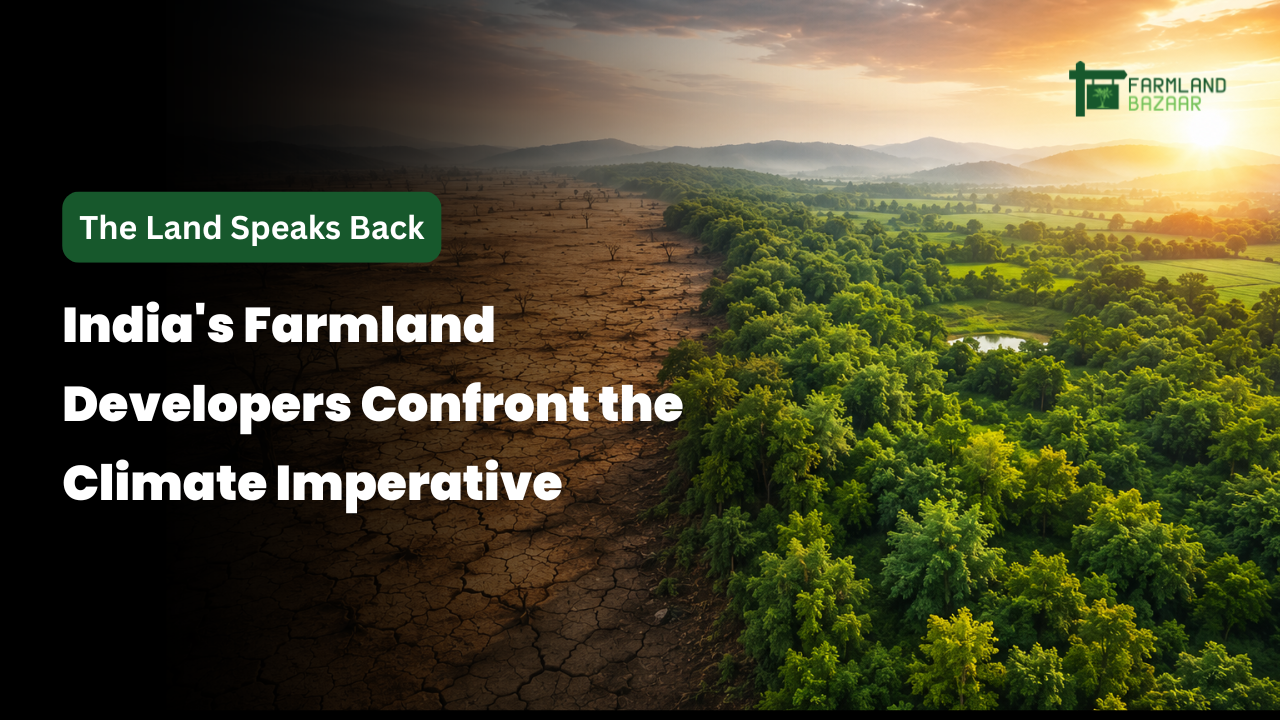
India's managed farmland sector has spent the last five years convincing investors that the earth underfoot is more than collateral; it is capital. But on World Environment Day 2026, as the United Nations rallies nations under the theme "Inspired by Nature. For Climate. For Our Future," the industry faces a more honest, more urgent question: is the land being restored, or merely monetised?
The context is stark. According to the National Bureau of Soil Survey and Land Use Planning, approximately 30% of India's land, around 146.8 million hectares, is degraded with water erosion accounting for the single largest share. Agriculture Minister Shivraj Singh Chouhan, addressing a global soil conference in November 2024, identified rising fertiliser consumption, imbalanced soil management and the overexploitation of natural resources as the primary drivers. Meanwhile, India holds the sobering distinction of being the world's largest consumer of groundwater, with the resource under acute stress in states like Karnataka, Tamil Nadu and Maharashtra; precisely where the managed farmland boom has been most concentrated.
Against this backdrop, the organised managed farmland segment, estimated at 20,000 to 25,000 acres, under management and valued between ₹5,000 and ₹7,000 crore as of 2024, according to FarmlandBazaar's Proprietary Data, cannot afford to look away. The developers shaping this market are increasingly being asked by buyers, regulators and their own conscience: what are you giving back to the land?
THE ORGANIC FARMING SHIFT
One structural shift is already underway. India's organic farming market, valued at $5.56 billion in 2024 by IMARC Group, is projected to grow at a compound annual rate of 10.4% through 2033, reaching over $13 billion. Government programmes like Paramparagat Krishi Vikas Yojana (PKVY) are actively incentivising chemical-free cultivation. For managed farmland developers, this is not merely an ethical nudge; it is a commercial signal. Buyers of farm plots are arriving with a new vocabulary: soil carbon, polyculture, water table, native species. The pitch that once began with IRR now increasingly begins with soil health reports.

Kaushik, MD, Saptha Ventures
"The farm is not a product we sell, it is an ecosystem we are accountable for. When we started, every conversation with a buyer began with projected returns. Today, it begins with a soil health report and a water table reading. That shift did not happen because we became idealistic. It happened because the land forced the question. Degraded soil yields less. Stressed aquifers raise costs. Climate risk is now underwriting risk. Nature is not an amenity on a managed farm, it is the business model."
WATER: THE DEFINING TEST
If soil health is the emerging conversation, water is the defining one. India extracted approximately 241 billion cubic metres of groundwater in 2023, against an annual recharge of 449 BCM which means the country draws down nearly 60% of its available resource every year. In Tamil Nadu, Chennai's aquifers were running at 127.5% of their recharge rate as recently as 2023. Coastal aquifers in the state have begun turning saline due to over-pumping, according to Central Ground Water Board assessments.
For managed farmland developers who have built estates around swimming pools, manicured lawns, and ornamental water features in water-scarce geographies, this is a reckoning. A growing cohort, however, is choosing to design around water differently — integrating rainwater harvesting, check dams, and natural ponds that recharge aquifers rather than drain them.

Amit Porwal, Director, Aranyakaa
"Bangalore extracts far more groundwater than its aquifers naturally recharge every year. When we conceived Project H2O, that single fact shaped every design decision we made. We did not want to build another estate that adds to the crisis but we wanted to build one that actively reverses it. Today, Project H2O operates with recharge ponds, harvesting systems, and water-positive infrastructure designed to make us fully self-sustaining in water within a defined timeline. A managed farm that ignores its groundwater footprint is a liability in the making. We chose to be the alternative."
CARBON AND THE NEW REVENUE LOGIC
A quieter opportunity is taking shape at the intersection of agroforestry and carbon markets. India announced plans for a domestic carbon trading market by 2026, and agroforestry programmes are already generating voluntary carbon credits with estimates suggesting farmers growing trees under such programmes can earn up to ₹10,000 per acre per year through verified credit sales. For managed farmland developers integrating native tree species into their estate design, carbon revenue is becoming a credible supplementary income stream alongside crop yields and land appreciation.

Charan Raj, Founder, Acarus Farm
"When you plant a Pongamia, a Neem, or an Indian Gooseberry on a managed farm estate, you are not doing landscaping; you are restoring a microclimate, building a carbon sink and generating a revenue stream that did not exist a decade ago. Agroforestry carbon credits are already a tangible income layer for Indian farmers. For managed farmland investors, integrating native species into their plot design is no longer a value-add, it is a differentiator that speaks to returns, to ecology and increasingly, to regulatory direction."
THE EVOLUTION OF THE FARMLAND BUYER
Alongside changing environmental expectations, developers say buyer behaviour itself has evolved significantly. Investors who once focused almost exclusively on appreciation and yield are increasingly scrutinising ecological performance metrics before making a purchase decision.
Nagarjuna Reddy, Founder, Mayookha Farms
"The buyer has changed, that much I can tell you. Five years ago the conversation was simple , it was about location, price, returns. That was it. Today people sit across from us and ask about groundwater levels, native tree cover, whether the organic claim is certified or just a line on a brochure. And the thing is, they already know the answers they are looking for. They have done the research before they walk in. The demand has grown, yes, but the buyer has grown with it. They are more informed, more specific, harder to impress with just a good view and a projected IRR."
WHAT THIS DAY ASKS OF THE SECTOR
World Environment Day 2026 is hosted by Azerbaijan and anchored in the UNEP theme "Inspired by Nature. For Climate. For Our Future" is a call, in the UN's words, not merely to reduce emissions but to repair our relationship with the climate systems that sustain us. For an industry that literally holds land, India's most consequential ecological and agricultural asset, in its hands, the theme lands with particular weight.
Indian farmland investments in select micro-markets around Bengaluru, Pune, Hyderabad and Chennai have historically delivered annualised returns of 12 to 15%, combining capital appreciation and passive income, per FarmlandBazaar's own research. The case for sustainable stewardship is not just ethical; it is financial. Degraded soil yields less. Depleted aquifers raise costs. Climate-stressed crops underperform. Nature, as the theme of this day reminds us, is not optional. It is the foundation on which every return is built.

Kamakshi Jyosna, Founder, Kshetha Group
"We are the only real estate category in India that is built entirely on living earth , not concrete, not steel, not glass. That gives us a responsibility that no office building or housing complex carries. When 30% of India's land is degraded, when aquifers are being drawn down faster than they recharge and when the global climate conversation has reached the urgency, the managed farmland developer who still treats ecology as a branding exercise is, quite simply, on the wrong side of history. And of the market."
A Question the Land Will Eventually Answer
As the managed farmland sector matures, buyers, regulators and local communities are likely to ask questions that go beyond appreciation forecasts and projected yields.
Has soil health improved? Has groundwater recharge exceeded extraction? Has biodiversity increased? Has the land become more resilient than it was before development began?
The most successful farmland projects of the next decade may not be those that simply generate returns from the land, but those that leave the land healthier than they found it. Because in the end, every managed farmland project makes a promise; not just to investors, but to the landscape itself. And over time, the land has a way of revealing whether that promise was kept.
Written by Farmland Bazaar Team
Agricultural assets advisor contributing to Farmland Bazaar v2. Focusing on organic investments, soil analysis reports, and deed checks.