
The Carrot Blueprint: How Phuman Singh Replaced Paddy With Carrots to Earn ₹1 Crore a Year
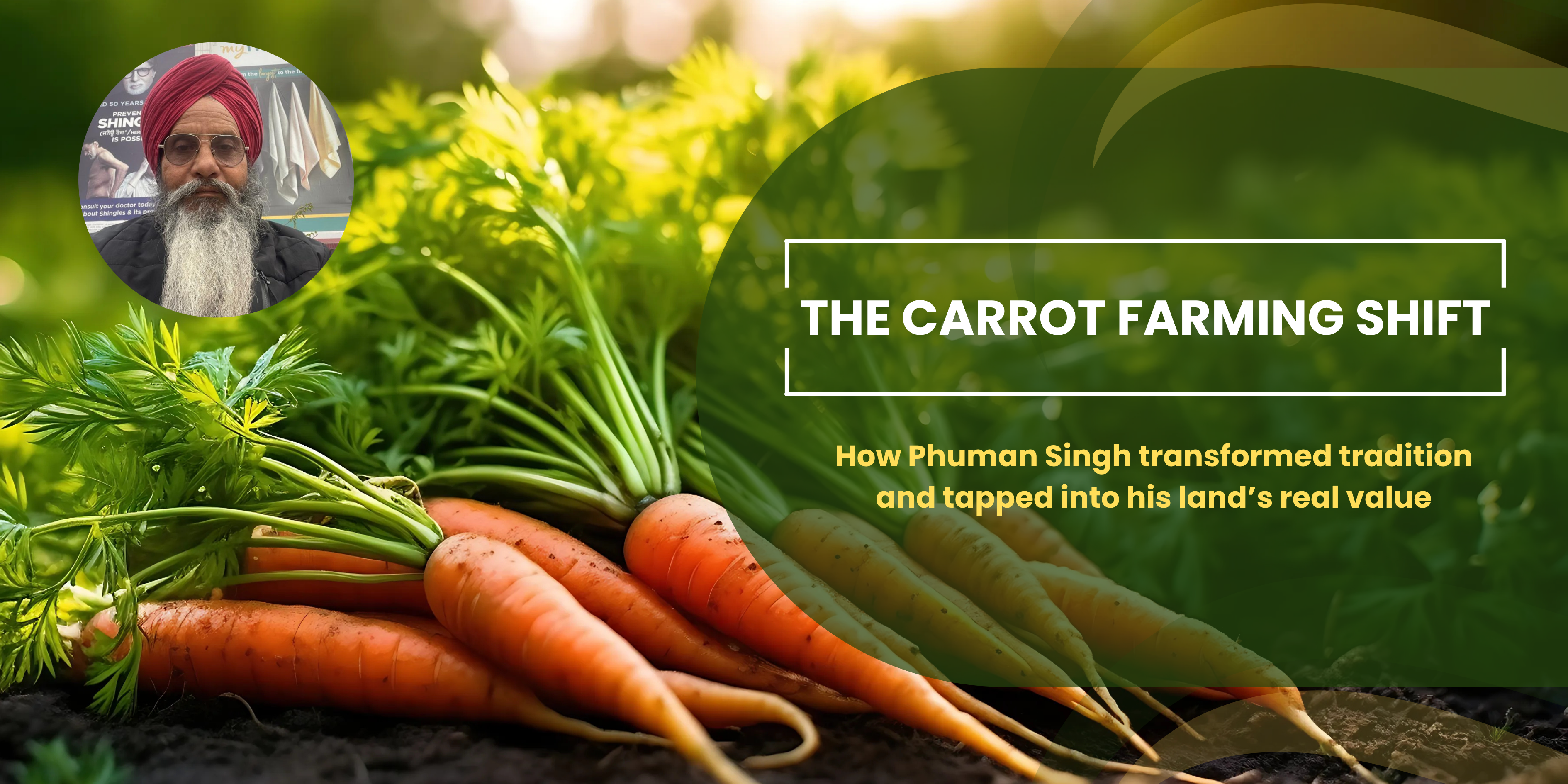
Every great farming story begins with more than just land—it begins with a vision.
For Phuman Singh Kaurra, a 65-year-old farmer from Paramjitpura (Allupur), Punjab, that vision took root nearly three decades ago, when he made a bold decision to abandon the conventional path of paddy and wheat cultivation. Instead, he placed his bet on a crop that many underestimated: the carrot.
Today, that gamble has transformed his family’s destiny. From just 4.5 acres, he now cultivates over 50 acres of carrots, has built a seed empire that supports 650+ acres of farming, and earns over ₹1 crore a year.
His story is not just about success—it's a blueprint for landowners and new farmers ready to unlock the full potential of their soil.
From Disappointment to Determination: The Spark Behind the Success
Born into a family of six siblings, Phuman’s early years were steeped in struggle. Financial hardship forced him to quit college in his second year and return to his family’s farm, where he worked on wheat and paddy fields, along with managing a small dairy and poultry operation. But the numbers didn’t add up—and Phuman knew something had to change.
In 1993, he noticed a neighboring farmer growing carrots. Intrigued, Phuman sought guidance—but was brushed off.
Instead of discouragement, that moment lit a fire in him.
“That day I told him: I’ll make a name for myself through carrots and show you, chacha,” he recalls.
Turning the Soil—and His Life—Around
Phuman started with 4.5 acres of carrot cultivation, using knowledge from books, nearby agricultural universities, and programs at Krishi Vigyan Kendra (KVK). His efforts paid off quickly.
Today, the Kaurra family owns 80 acres, with Phuman personally cultivating 50 acres of carrots every year. Beyond that, he has become a master seed producer, growing and selling high-quality carrot seeds at ₹1,000–1,500 per kg.
His seeds are now used by farmers across Punjab to grow crops on over 650 acres of land.
Mastering the Carrot Crop: The Phuman Singh Way
“Carrots have never disappointed me.” — Phuman Singh
Over the last 30 years, Phuman Singh from Paramjitpura, Punjab, has built a thriving carrot farming business that now earns his family over ₹1 crore annually. His journey is proof that with patience, learning, and smart choices, even a small farmer can build a carrot empire.
If you’re a new farmer or considering a shift from wheat and paddy, here’s how you can follow in his footsteps.
Step 1: Start with the Soil – It All Begins Here
Phuman’s first and strongest piece of advice: “Prepare your land like you’re preparing a bed for your child.”
- Soil Type: Sandy loam or light-textured soil works best. If you have heavier soil, mix in organic matter like compost or sand to loosen it.
- Ploughing: Deep ploughing (at least 1–1.5 feet) is crucial. This helps the carrots grow straight and deep. Phuman’s fields are tilled 2–3 times to get the perfect texture.
- Organic Boost: Before sowing, apply well-decomposed manure or vermicompost. This improves soil health and root development.
- Step 2: Sowing the Seeds the Right Way
Phuman’s carrot season begins between 15 September and 15 October—just after the maize or rice harvest.
-
Seed Variety: Use locally proven, high-yielding varieties. Phuman now grows his own seeds and sells to others.
- Sowing Method:
a. Create ridges in the field.
b. Sow seeds manually or use a seed drill for precision.
c. Spacing: Maintain about 1.5 feet between ridges. - Seed Rate: Use 4–5 kg of seed per acre.
- Moisture Matters: Give a light irrigation after sowing to help germination.
Step 3: Regular Care = Healthy Carrots
Carrots need consistency. According to Phuman:
“The first month is like raising a baby — daily attention is a must.”
-
Irrigation: Water every 7–10 days. Don’t overwater — just keep the soil moist.
-
Weeding: Manual weeding is key in organic farming. Phuman often uses mulching to suppress weed growth naturally.
-
Keep an eye out for pests early. Organic neem sprays can help, but prevention is better than cure.
Step 4: The Harvest – Your Reward
Phuman’s harvest begins around 20 December and continues till 25 March.
-
Maturity Period: Carrots are usually ready in 90–100 days.
-
Yield: On a good day, Phuman harvests 110 to 250 quintals per acre.
-
Before Harvest: Lightly irrigate to soften the soil. This makes pulling out carrots easier and reduces damage.
-
After Harvest: Wash the carrots clean and sort them before sending them to market—or better yet, let the buyers come to you, just like they do to Phuman.
*Bonus Tip: Grow Your Own Seeds
About 10 years ago, Phuman started growing his own seeds. Now, he produces enough to cover over 650 acres. He sells his seeds for ₹1,000–1,500 per kg. This matters because growing your own seeds gives you control, improves quality, and creates an additional income stream.
From Seed to Support: A Farmer, Teacher & Mentor
Phuman’s house is now a carrot farming school. Every day, at least four farmers visit him to learn directly. He teaches both in-person and by visiting their fields.
“No young farmer leaves without answers,” he says proudly.
He is living proof that formal education is not a barrier to farming success. With the right mindset, dedication, and willingness to learn—anything is possible.
Your Land is Waiting for Its Story
Phuman Singh didn’t inherit prosperity—he cultivated it. And the journey has brought him more than income his sons studied abroad, he owns a modern home and bought advanced farming equipment and also earned the respect of his peers, the admiration of agri-experts and the trust of markets far and wide
If you are a landowner, you are already halfway there. You have the most crucial asset: the land. Starting with a simple, rewarding crop like carrots can be your gateway into the fulfilling world of organic farming. It’s a journey that promises not just financial returns, but a deeper connection to the earth and the food it provides.
Your legacy, like Phuman, is waiting to be cultivated. Why not let it begin with a carrot?
Frequently Asked Questions
Q1. How long do carrots take to grow?
Ans: Carrots typically take about 90 to 110 days (around 3 to 4 months) from sowing the seed to being ready for harvest. The exact time can vary slightly depending on the specific carrot variety, soil conditions, and local climate. The key indicators for readiness are the development of a good root size and the vibrant reddish-orange color characteristic of the variety you have planted.
2. Is carrot farming profitable?
Ans: Yes, carrot farming can be highly profitable, especially when compared to traditional grain crops. Its profitability is driven by several factors: high yield potential (expert farmers can achieve up to 200 quintals per acre), consistent and strong market demand throughout the year, and the potential for premium pricing for high-quality, well-formed organic produce. By focusing on good soil preparation to maximize yield and quality, farmers can secure excellent returns and build a sustainable income.
3. Which month is best for carrot farming?
Ans: The best time for sowing carrot seeds in most parts of India is from August to November. Carrots are a cool-season crop and thrive in the moderate temperatures of the post-monsoon and early winter months. Sowing during this period allows the carrots to mature in pleasant weather, which is ideal for root development and results in a sweeter, better-quality harvest.
Learn about managed farmlands and their demand in the future.
Written by Farmland Bazaar Team
Agricultural assets advisor contributing to Farmland Bazaar v2. Focusing on organic investments, soil analysis reports, and deed checks.