
Harvesting Certainty: Why Polyhouse Farming Is India’s Game‑Changer for High‑Value Agriculture
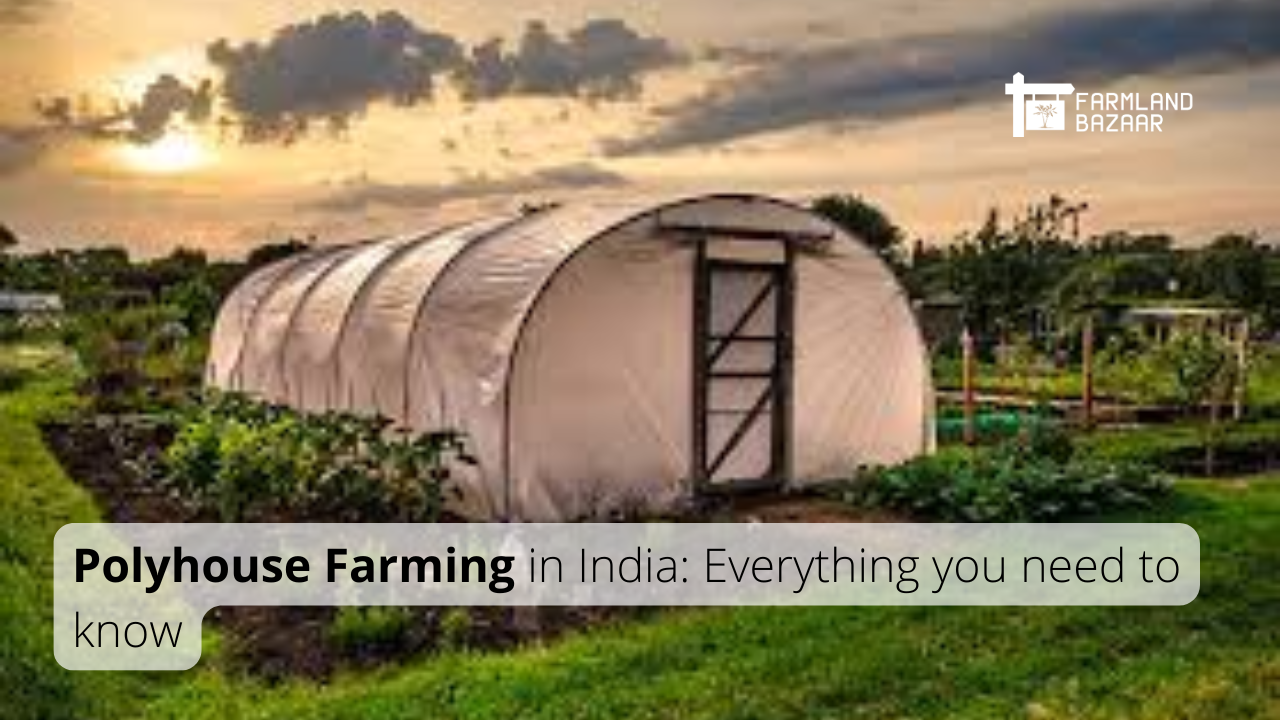
India’s agricultural destiny is being rewritten under transparent roofs. In a country where climate surprises—unseasonal rains, heatwaves, hailstorms—are becoming the new normal, polyhouse farming offers more than refuge: it offers profitability, predictability and most importantly, premium returns.
Protected cultivation using polyhouses is no longer niche—it is fast becoming essential for anyone who wants consistent harvests of high‑value crops, irrespective of weather. For growers who are done with losing crops to storms or pests, or for entrepreneurs seeking returns where traditional farming’s yields and margins are too volatile, polyhouses deliver controlled microclimates, higher quality produce, off‑season advantage and — crucially — policy‑driven financial support that makes scaling realistic.
In this post, we delve into how polyhouse farming works, what makes it commercially viable in India today, and how supportive policy frameworks have transformed what was once expensive risk into strategic opportunity. Whether you’re a farmer, an agribusiness investor, or someone exploring farmland / protected cultivation, by the end you’ll understand why polyhouse farming may be the smartest agricultural bet for the 2020s.
Let’s start with understanding Polyhouse
What is Polyhouse? A polyhouse is a type of protected cultivation structure—essentially a frame covered with UV‑stabilised polyethylene sheet (or similar translucent material)—designed to create and maintain favorable growing conditions inside. The goal is to control external environmental factors such as temperature, humidity, wind, sunlight and precipitation.
Key features:
-
The covering material lets in sunlight but reduces heat loss, shields from harsh sun rays, heavy rain, hail, and strong winds.
-
Structures are ventilated (naturally or mechanically), may include shading, cooling, and sometimes climate control systems for temperature and humidity regulation.
-
Irrigation is usually precise: drip or fertigation systems are common, reducing water wastage and delivering nutrients more efficiently.
Why this matters: with a polyhouse, farmers can grow crops year‑round (including off‑season), protect from pests and disease, often produce better‐looking and longer‑lasting produce, and get premium prices because of better quality and timing.
Choosing the Right Polyhouse: Tech Levels, What They Cost & What Govt Supports
Polyhouse farming isn't one‑size‑fits‑all. There are simpler, low‑cost versions, and there are full‑blown, tech‑heavy ones. The government sets cost “norms” (maximum limits) tied to subsidies, so it helps to know which level you fall into.
1. The Three Tech Levels (and What You Get)
Here are the main types of polyhouse / protected structures, how fancy they are, and how much you’ll approximately spend:
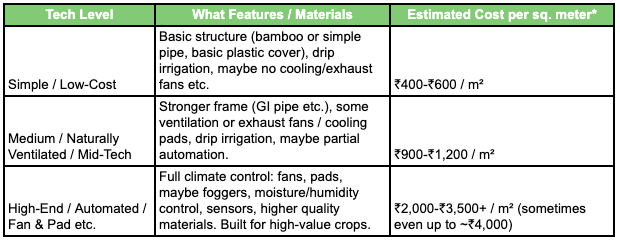
*Costs vary by location, material quality, terrain; real prices can go up or down.
2. What Govt Subsidies (Cost Norms) Look Like
The government sets ceilings (“norms”) for what costs are considered eligible for subsidy. If your cost is more, only the part up to the ceiling gets a subsidy; the rest you’ll pay yourself.
-
For simpler / low‐cost polyhouses, the norm might be around ₹500 per sq. meter including the drip irrigation unit.
-
For more durable, naturally ventilated polyhouses (without elaborate automation), the government norm often is around ₹750 per sq. meter, again including mandatory items like drip/fertigation etc.
-
When you go for high‑tech (fan & pad, sensors, etc.), actual costs can be way higher but subsidy is still calculated only up to the standard norm (like ₹750 etc.). So you must plan for extra investment.
3. What It Means for You As An Investor / Farmer
-
If you build a simple or medium polyhouse, you can probably align your costs with gov norms so subsidy covers a good chunk.
-
If you build a fancy, fully automated polyhouse, you’ll face a “gap” — subsidy covers up to the gov limit (norm), rest must come out of your pocket or through other financing.
-
Terrain matters: in hilly or difficult terrain, costs tend to be ~15% higher, and norms sometimes adjust for that.
-
Maintenance, replacement of films, electricity for fans etc are recurring costs that need budgeting — fancy polyhouses save some things but add others (e.g. power, monitoring).
Let’s say you want a 1‑acre naturally‑ventilated polyhouse (mid‑tech), costing maybe ₹32 lakhs before subsidy. If government subsidy is 50%, and norms allow you to claim up to a certain ceiling, you may get back ~₹16‑₹17 lakhs (depending on state/terrain). Then your net investment is the rest.
Agronomic & Commercial Advantages (Shorter Version)
-
Risk Reduction: Polyhouses shelter crops from extreme weather—heavy rain, heat waves, strong winds—making production more reliable than in open fields.
-
Better Crop Viability & Higher Profits: They enable off‑season cultivation of high‑value crops (e.g. capsicum, tomato, cucumber, exotic flowers). These fetch premiums in both price and quality.
-
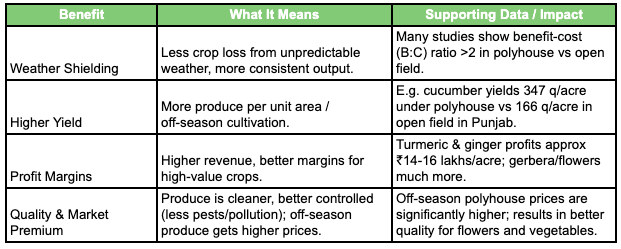
Strong Financial Returns: Some examples: turmeric & ginger in polyhouses can yield profits of ~₹14‑16 lakhs/acre; gerbera and roses even more.
-
Improved Yield & Market Access: Polyhouse crops often yield 1.5‑3× more than open fields, and produce is sold off‑season when prices are higher.
Polyhouse vs Open‑Field — Key Advantages
The Central Policy Ecosystem: MIDH and NHB Frameworks
A. What is MIDH & How It Works
-
MIDH (Mission for Integrated Development of Horticulture) is the central scheme that supports horticulture growth across India — covering fruits, vegetables, flowers, spices, and more.
-
It brings under one roof older schemes like NHM, HMNEH, NHB, etc., so that support is more coordinated.
-
For most states, GOI contributes 85% of the cost and states contribute 15%. In the North East and Himalayan states, GOI covers the entire 100%.
-
MIDH isn’t just about subsidies. It also supports:
B. Role of NHB & How Projects Are Approved
-
The National Horticulture Board (NHB) is the key body under MIDH that focuses on high-investment horticulture projects—especially ones involving protected cultivation (polyhouses, greenhouses) and infrastructure.
-
The process for farmers / project proponents typically involves:
-
Applying locally (village / block level) with project details
-
Verification at block/district levels to check eligibility
-
A bank or financial institution authorized by NHB carries out a due-diligence / financial appraisal
-
Work begins only after approval, and subsidy is released after project completion and verification (back-ended model)
C. Policy Safeguards & Risk Sharing
-
Because subsidy is credit-linked and back-ended, the farmer invests or borrows first; subsidy is disbursed only after work is done and verified. This ensures accountability.
-
Also, requiring bank appraisal / FI scrutiny before approval delegates financial risk assessment to institutions familiar with project viability. This reduces misuse of funds.
-
In effect, this policy design ensures that only credible, technically sound projects receive subsidies. It protects public money and increases the chance projects succeed.
Financial Mechanics: Subsidy Structures & the ₹56 Lakh Incentive
A. Back-Ended, Credit‑Linked Subsidy
In NHB’s commercial horticulture / protected cultivation schemes, the subsidy works on a credit‑linked, back-ended model. That means:
-
The investor must first raise 100% of project costs (via bank loan or own capital) and complete the construction to required specifications.
-
Only after the project is verified and approved will the subsidy amount be disbursed — typically via reimbursement or credit adjustment to the loan.
-
The verification is done by authorized agencies through inspections, completion certificates, etc.
This ensures that subsidies are paid only when work is done properly, reducing misuse or substandard implementation.
B. The ₹56 Lakh Subsidy Cap (NHB Scheme‑3 for Protected Cultivation)
Core terms:
-
Subsidy Rate: 50% of the Eligible Project Cost (EPC) for projects that qualify.
-
Subsidy Cap: Even if your project is much larger or costlier, the maximum subsidy you can receive is ₹56.00 lakh per project in general (non‑hilly) areas.
What this means in practice:
-
To fully realize the ₹56 lakh subsidy at 50%, your project’s audited EPC must be at least ₹1.12 crore (because 50% of ₹1.12 crore = ₹56 lakh).
-
If your EPC is less than ₹1.12 crore, you get 50% of actual cost (subject to norms).
-
If EPC is higher than ₹1.12 crore, your subsidy remains limited to ₹56 lakh; you must self‑finance the excess cost beyond the norm.
C. Variations & Regional Adjustments
-
In North East (NE) / Hilly / Scheduled areas, similar subsidy is available, but the norms / caps may differ or be more favorable in some cases.
-
For other integrated horticulture / post-harvest / infrastructure schemes, the subsidy rates and ceilings differ — e.g., in some areas it might be 40% subsidy or lower caps
Cost Norms, Project Scale & What Components Qualify
A. NHB Cost Norms & Maximum Structure Costs
The government has fixed norms — ceilings — for how much of the structure’s cost is subsidy‑eligible. These norms include certain essentials (like drip irrigation). You can build more elegantly, but subsidy won’t cover beyond these ceilings.
-
Low‑Cost Polyhouse: ceiling of ₹500 per sq. meter, inclusive of drip irrigation.
-
High‑Cost (Naturally Ventilated) Polyhouse: ceiling of ₹750 per sq. meter, inclusive of drip irrigation.
-
Shade Net House: ceiling of ₹250 per sq. meter, again inclusive of basic irrigation.
-
For floriculture crops, there is also an allowance for bed preparation (soil mix, media, etc.) — limited to ₹100 per sq. meter (or actual cost, whichever is less).
-
In hilly / difficult terrain, norms recognize that construction costs are higher — typically, ~15% extra is allowed for tubular structures relative to plain areas.
B. Project Cost Ceilings (Integrated Projects)
Subsidies are calculated on the Eligible Project Cost (EPC), which includes structure, cultivation, and add-on components. But each crop / activity has a maximum ceiling on how much total cost is considered.
Here are example ceilings (per acre) for protected cultivation projects:
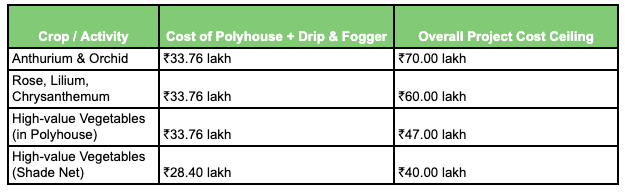
These ceilings help ensure subsidies are directed toward viable, scalable projects rather than over‑investment in expensive components.
C. How to Reach the EPC Threshold: Use Add-On Components
To fully utilize the subsidy (for example, to hit the ₹1.12 crore EPC necessary for the maximum ₹56 lakh subsidy), you often need more than just the polyhouse structures. Smart project design should include add-on elements to boost EPC legitimately.
Some of the eligible add-on components:
-
Land development: leveling, fencing, pits, paths. Up to 15% of EPC (excluding land/structure).
-
Cost of land (if newly purchased): can be counted up to 10% of EPC (within limits).
-
Post‑Harvest / Processing / Logistics facilities: pack houses, cold storage, ripening chambers, pre‑cooling units, etc.
By bundling these with the protected cultivation, you can raise your EPC to reach the subsidy threshold and make full use of government support.
State‑Specific Policy Divergence & Regional Incentives
A. Stacking Subsidies: How States Amplify Central Support
-
While NHB / MIDH gives a foundational 50% subsidy (with a cap), many states layer on state-level subsidies or grants. This “stacking” can push total support for some projects as high as 70–75%, or even 95% in select cases (for marginalized groups, e.g. SC/ST farmers).
-
The highest subsidy percentages (80% or more) are usually reserved for low-cost or simple polyhouse types, making them affordable to small and marginal farmers.
-
In states like Telangana and Haryana, special schemes grant extra support for SC/ST or smallholders, driving adoption and social equity.
B. Regional Examples & Best Practices
Jammu & Kashmir (J&K)
-
The state offers an 80% subsidy for farmers who build polyhouses—so the farmer pays only 20%.
-
This is particularly effective for simpler polyhouse designs suited to local conditions.
Uttar Pradesh (UP)
-
UP has rolled out a 50% subsidy for polyhouse / greenhouse systems under its Integrated Horticulture Mission, across 44 districts.
-
The intention: to enable off-season cultivation of vegetables like chillies, bell peppers, tomato, cucumber—helping farmers fetch premium rates and ensure steady supply.
-
UP also aligns this with its Food Processing Policy, offering 35% capital subsidy on plant, machinery, civil work, etc., for food processing units (FPIs).
-
Strategically, a farm enterprise can get ~50% subsidy for its production (polyhouse) and another ~35–50% for downstream infrastructure like cold storage, value-add units, etc. This synergy supports the full farm-to-market model.
High-adoption states
-
States with strong horticulture sectors often offer generous incentives: Telangana, Karnataka, Maharashtra, Kerala, Tamil Nadu.
-
These schemes underscore how serious states are about promoting climate-resilient farming.
C. Implementation Roadmap: Applications, DPRs & Compliance
1. Application & Pre-requisites
-
The process begins with an application through the state horticulture department or nodal agency.
-
Required documents: land ownership / rights papers, identity proofs, technical certifications (for cold storage etc.), and the prescribed application form.
2. Detailed Project Report (DPR)
-
The DPR is the blueprint of your project: structural design (as per NHB norms), cost estimates, revenue projections, cash flow, etc.
-
It must receive approval from a bank or financial institution (via a Detailed Appraisal Note) before work can start. This ensures the project is financially viable and meets standards.
3. Compliance & Subsidy Claim
-
During construction, you must strictly adhere to the technical specifications in the approved DPR and NHB guidelines. Deviations may lead to the denial of subsidy.
-
Keep meticulous records of all expenditures, invoices, and work done. Because subsidy is back-ended, delays or documentation errors slow down the payout.
-
After project completion, an inspection and verification are done. Once all is approved, subsidy is paid (often via DBT) to your bank account.
Commercial Viability & ROI: What Returns Can You Expect?
A. Premium Pricing & Year-Round Cultivation
-
By enabling off-season or continuous cultivation, polyhouses let you sell produce when supply is low and prices are high.
-
High-value vegetables, exotic flowers, specialty crops—these do well under controlled environments and command better margins.
B. Financial Modelling & Leverage of ₹56 Lakh Subsidy
-
Suppose you design a project with EPC = ₹1.12 Crore, spread over two acres in floriculture (overall cost ceiling ~₹70 lakh/acre) and include post-harvest infrastructure.
-
You can claim the full ₹56 lakh subsidy, reducing your net capital burden to ₹56 lakh (ignoring interest / working capital).
-
If net profit is ~₹14 lakh per acre annually, two acres yield ~₹28 lakh per year—and you recover your investment in about 2 years (consistent with many industry estimates).
C. Risks, Sustaining Viability & Mitigation
-
High-tech systems (Fan & Pad, sensors, climate control) are prone to operational risk: power failures, equipment breakdowns, lack of skilled operators.
-
To manage this:
-
Install backup power systems (generators / solar + battery)
-
Invest in capacity building / training
-
Adopt monitoring, periodic maintenance
-
Government programs often include technical training and extension support to help growers maintain performance over time.
Conclusion & Expert Recommendations
The MIDH + NHB subsidy structure makes commercial polyhouse farming far more viable. The ₹56 lakh, credit-linked, back-ended subsidy can dramatically reduce risk—if you design projects wisely.
Key Actions:
-
Integrate value‑chain components (cold storage, ripening units, etc.) so your project’s EPC reaches ₹1.12 crore and you qualify for the full subsidy.
-
Stick to technical specs & document everything—even small deviations can jeopardize subsidy payment.
-
Pick the right subsidy path—for big, high-tech setups, NHB’s scheme is ideal; for simpler structures or in certain states, combine central + state subsidies wisely.
-
Plan for operations & risk—power backup, skilled labor, maintenance are essential in controlled environments.
By integrating value-chain components, adhering to technical specifications, selecting appropriate subsidy schemes, and proactively managing operational risks, stakeholders can enhance the viability and profitability of polyhouse projects. These strategic actions not only optimize the benefits of available subsidies but also contribute to the long-term success and sustainability of protected cultivation ventures.
Sources:
farmatma.in/Polyhouse Farming Guide (2025) - Types, Construction Cost & Profit - FarmAtma
nhb.gov.in/COST NORMS AND PATTERN OF ASSISTANCE
mofpi.gov.in/Schemes of National Horticulture Board - Ministry of Food Processing Industries
nhb.gov.in/Revised approved Cost Norms of various components of National Horticulture Board
nhb.gov.in/Technical Standards for Naturally Ventilated, Fan & Pad Green House and Shade Net House
nhb.gov.in/Guidelines for Making Subsidy Claims - National Horticulture Board
agrifarming.in/Polyhouse Subsidy, Cost, Profit, Project Report | Agri Farming
Written by Farmland Bazaar Team
Agricultural assets advisor contributing to Farmland Bazaar v2. Focusing on organic investments, soil analysis reports, and deed checks.