
Rainwater Harvesting: Beyond Amenities, Towards A Resilient Farmland
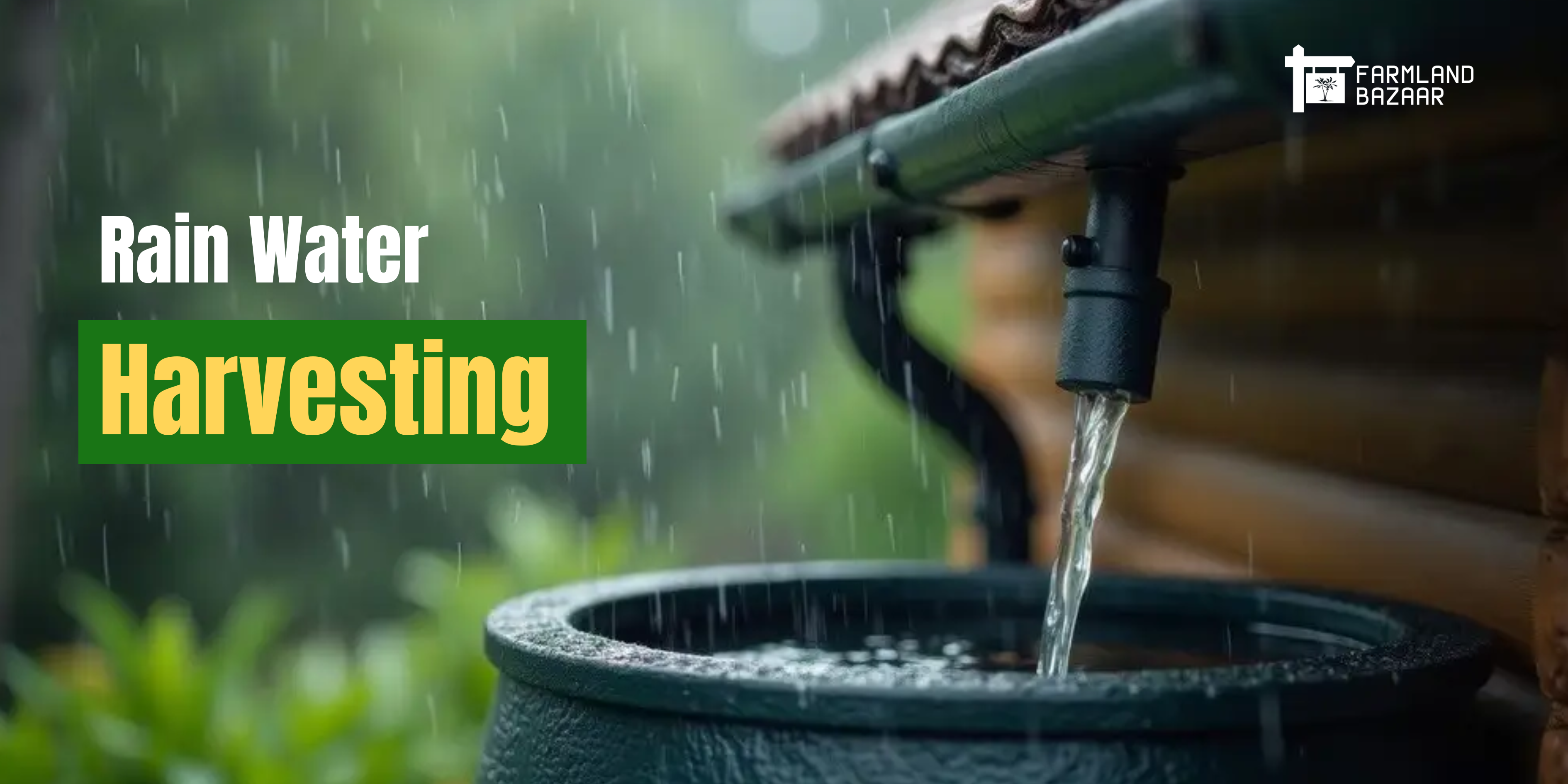
Most of the managed farmlands today market themselves on the basis of proximity to the city or appreciation or amenities. However, there are many other factors that determine whether land is truly a productive asset. One critical question is: Where does the water come from and where does it go?
In a city like Bengaluru, where the water crisis worsens every summer, it becomes even more important to understand a project’s water source, usage patterns and recharge/recycle systems. This applies regardless of whether the property is a plot, an apartment or a managed farmland.
Also, with increasing climate volatility, monsoons are more unpredictable than ever before. As a result, recycling, recharging and harvesting water are no longer just green features but they represent a green future and have become more essential than ever.
Rainwater harvesting plays a major role in determining the productivity of farmland. No landowner wants to deal with dry patches or struggle every weekend to arrange water for crops and other essential requirements.
The Story of Two Farms
Imagine two neighbors, Ajay and Rohan, who bought one-acre plots near Bengaluru. Ajay spent his budget on a fancy gate and a clubhouse membership. Rohan, however, spent his first few months digging narrow trenches along the slopes of his land and building a small, lined pond at the lowest corner.
When a massive monsoon hit, Ajay watched the heavy rain wash away his expensive topsoil, leaving behind rocky patches. Rohan’s trenches caught that same water, slowing it down and letting it soak deep into the earth. By the time summer arrived, Ajay’s borewell was running dry, and he was paying ₹1,200 per tanker to keep his plants alive. Rohan’s borewell stayed strong because he had "banked" the monsoon underground.
Understanding the Borewell failure
Once considered a sure-shot solution to water scarcity, digging a borewell is now increasingly failing. The reality is that simply drilling deeper does not address the root cause of the crisis. Infact cities like Bengaluru and Hyderabad, borewell depths have plummeted from 300ft to 1,500ft+ in just a decade. Let's understand why the crisis?
The answer lies not in rainfall shortages, but in poor water infrastructure, unplanned land use, and weak groundwater recharge systems. India receives an average annual rainfall of nearly 1,100 mm, yet 50–60% of this water is lost as surface runoff due to inadequate land design and absence of effective rainwater harvesting. As a result, despite adequate rainfall, India has become the world’s largest extractor of groundwater, placing severe and unsustainable pressure on underground aquifers. According to the Central Ground Water Board (CGWB) National Compilation 2023, more than 30% of assessed groundwater blocks in the country are already under stress.
What Is Rainwater Harvesting ?
Rainwater harvesting is not just about installing a tank or diverting water from a roof. At its core, it is the practice of capturing rain where it falls, slowing it down, storing it and allowing it to recharge the land and groundwater instead of letting it run off and disappear.
Before high-voltage pumps, India was a Hydrological Civilization. From the Johads of Rajasthan to the Temple Tanks of South India, our ancestors understood one rule: Slow it, Spread it, Sink it. Smart managed farmlands today are reinterpreting this logic using:
- Contour Swales: Trenches dug along the level of the land to stop water from racing downhill.
- Recharge Shafts: Directing "lost" rain straight into the deep aquifers.
- Percolation Ponds: Strategic "mini-lakes" that act as the farm’s savings account.
Good harvesting systems work across the entire landscape, not just rooftops. They include land shaping, soil treatment, recharge structures and storage; all working together as one water architecture.
A recent and noteworthy example of effective rainwater harvesting from Bengaluru is H₂O by Aranyakaa Farms. The project focuses on capturing, storing and recharging rainwater at scale, rather than relying on deeper borewells. The project integrates 20–30 rainwater harvesting recharge pits, deep recharging wells and a 2.5-acre man-made lake, ensuring that monsoon rainfall is retained within the land and directed back into the aquifers.
Key Questions Every Buyer Should Ask Before Investing
Whether you’re buying a plot, an apartment or a managed farmland, these are non-negotiable questions (Given the water scarcity):
- How much rainwater does this land receive annually, and how much is retained on-site?
- What percentage of rainwater runs off versus recharges the soil and aquifers?
- Are there contour trenches or land slopes designed to slow water?
- Is there any recharge pit or storage system and how is it maintained?
- Is the borewell supported by recharge or is it purely extractive?
If a developer cannot answer these clearly, the project is likely water-dependent, not water-secure.
Conclusion
For buyers and developers, the choice is simple. Land without water planning is a gamble and Land with a water architecture is a green asset. Water conservation practices like rain water harvesting is not an add-on but a foundation of long-term productivity. Projects that treat water as an afterthought will continue to struggle with tanker dependency, declining soil health and rising costs. Those that design water into the land itself will remain productive long after others dry up.
Farmland Bazaar encourages water security and conservation by educating buyers on the importance of water planning and guiding developers to adopt sustainable practices that include water conservation, reuse, recharge and recycle
Written by Farmland Bazaar Team
Agricultural assets advisor contributing to Farmland Bazaar v2. Focusing on organic investments, soil analysis reports, and deed checks.