
TG RERA Slams Developer with ₹25.8 Lakh Fine for Illegal Farm Plot Sales and RERA Violations
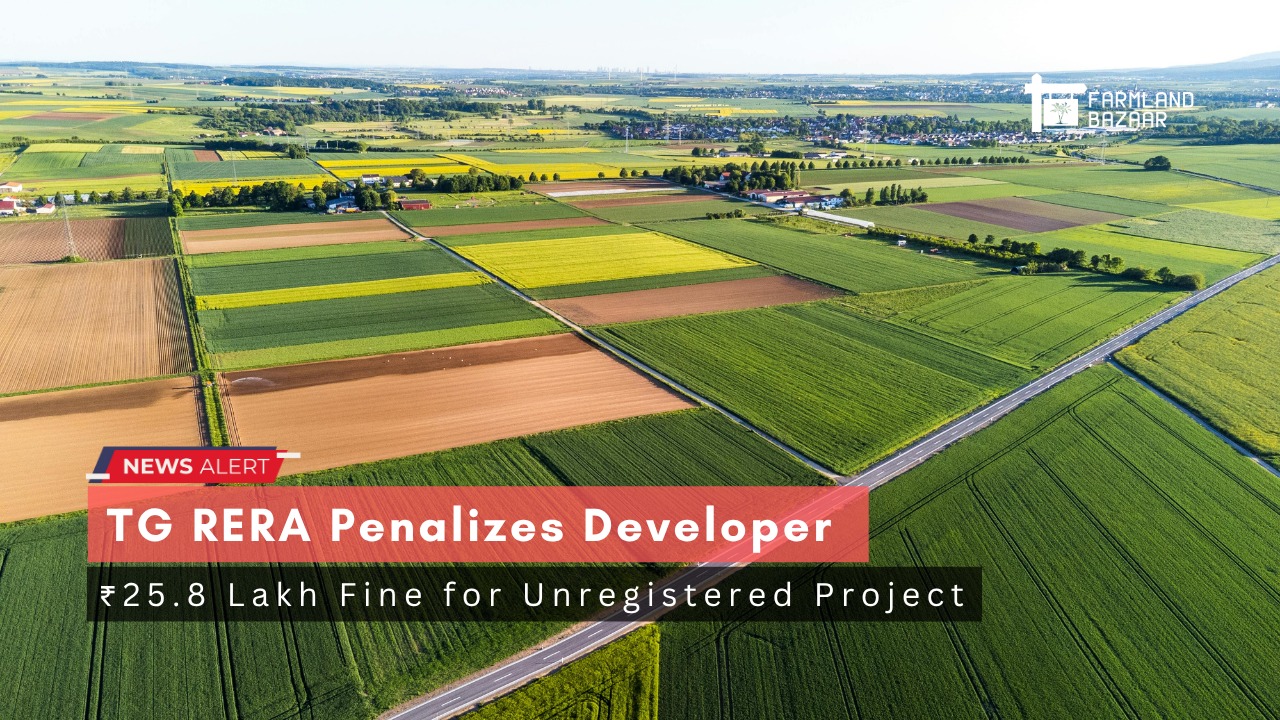
Hyderabad: The Telangana Real Estate Regulatory Authority (TG RERA) has taken stringent regulatory action against a city-based developer, Sunrise Infra Properties, by imposing a substantial penalty of ₹25.8 lakh. The firm was found to be in gross violation of the Real Estate (Regulation and Development) Act, 2016 (RERA), specifically for advertising and selling plots in its project, Siri Vanam, without securing the mandatory governmental approvals and the requisite RERA registration.
The regulatory body’s decisive order underscores its commitment to ensuring transparency and accountability in the state’s burgeoning real estate sector, particularly against developers attempting to circumvent the law through unauthorized land development and misrepresentation of agricultural properties.
Details of the Egregious Violation
The core of the violation centered on the illegal conversion and sale of agricultural land. TG RERA initiated action based on a specific third-party complaint, which alleged that Sunrise Infra Properties was actively marketing and selling subdivided agricultural land as desirable 'farm plots' within the Siri Vanam project.
An investigation conducted by the Authority confirmed that the company proceeded with promotional activities and sales without obtaining critical statutory clearances, including:
-
Layout approval from the competent planning authority.
-
Land conversion (from agricultural to non-agricultural/residential) certificates.
-
Project registration under Section 3 of the RERA Act.
The Authority meticulously reviewed supporting evidence, including registered sale deeds, official marketing brochures, and encumbrance certificates, which definitively established the company’s pattern of illegal activities. These documents confirmed that Sunrise Infra Properties was inviting buyers and entering into transactions for plots in a project that legally did not exist as a registered real estate venture.
Developer’s Defense Rejected by the Authority
Following the initial complaint, a show cause notice was issued to Sunrise Infra Properties in April 2025. In its response, the developer denied the charges, claiming the land was still agricultural and not meant for development. It also argued that no active marketing or advertisements were made, and even questioned the validity of the electronic evidence shared by the complainant.
TG RERA dismissed these defenses, stating that any kind of public solicitation — including brochures, listings or even sale deeds — qualifies as advertising under the RERA Act. Once such promotion begins, registration is mandatory. The Authority made it clear that developers cannot bypass the law by labeling projects as “agricultural land sales” or pleading ignorance.
This ruling reinforces a crucial point: any real estate activity involving public sale or promotion must be registered under RERA — no exceptions.
RERA’s Powers and Precedential Ruling
This order stands as a firm precedent in Telangana against the widespread practice of unauthorized plot sales. The Real Estate (Regulation and Development) Act, 2016, was established primarily to regulate transactions, protect consumers, and infuse financial discipline into the sector.
Section 3 of the Act strictly mandates that no promoter shall advertise, market, sell, or invite persons to purchase any plot, apartment, or building in a real estate project without first registering it with the respective State RERA. The penalties for non-registration, outlined in Section 59 of the Act, are severe and can extend up to 10% of the estimated cost of the real estate project. The ₹25.8 lakh fine imposed on Sunrise Infra Properties reflects the gravity of its non-compliance and the scale of the illegal marketing campaign.
The Final Order and Immediate Consequences
In its final directive, the Telangana Real Estate Regulatory Authority issued a multi-pronged order to ensure both compliance and consumer protection:
-
Financial Penalty: Sunrise Infra Properties was commanded to pay the fine of ₹25,80,000 to the TG RERA fund within a strict period of 30 days from the date of the order.
-
Cessation of Activity: The developer was immediately restrained from all activities concerning the Siri Vanam project, including advertising, booking, and selling any plots, until it has secured all necessary governmental and regulatory approvals.
-
Mandatory Registration: The promoter was explicitly directed to register the project with TG RERA once all requisite permissions, including layout and land conversion, have been officially obtained.
-
Public Caution: Furthermore, TG RERA will issue a public notice to caution prospective buyers against undertaking any transactions—purchase, booking, or deposit—in the Siri Vanam project until the company achieves full compliance with the RERA Act.
The case involving the ₹25.8 lakh penalty on Sunrise Infra Properties by the Telangana Real Estate Regulatory Authority (TG RERA) for the illegal sale of farm plots in the Siri Vanam project provides a critical, non-negotiable legal clarity for developers.
The fundamental distinction being reinforced by TG RERA is:
In Telangana, mandatory RERA registration is not required for a simple, as-is sale of agricultural land. However, it becomes compulsory if a developer is converting, dividing, and selling the land as part of a larger planned residential or commercial project that includes promised infrastructure.
The moment a developer attempts to create a "layout" and sells plots with common amenities, it falls squarely under the RERA Act. The TG RERA ruling, based on the complaint from the Chief Editor, Four Sides Network Pvt. Ltd., and the Authority's subsequent investigation, confirmed that marketing agricultural land as "farm plots" with a proposed clubhouse and internal roads constitutes a full-fledged "Real Estate Project."
Key Takeaways for Farm Plot Developers in Telangana
Developers engaged in plotted development, especially those marketing plots in agricultural zones, must adhere to a strict compliance checklist to avoid the heavy financial and legal consequences faced by Sunrise Infra Properties:
|
Compliance Checkpoint |
TG RERA Mandate and Required Action |
|
1. Land Status & Conversion |
Convert First, Sell Later: Obtain mandatory Non-Agricultural Lands Assessment (NALA) Act conversion from the relevant authority (e.g., Collector/Tahsildar) to legally change the land use from agricultural to residential/non-agricultural before subdivision or marketing. |
|
2. Layout Approval |
Sanctioned Plan is Essential: Get the official layout approval from the competent planning authority (like HMDA or DTCP). Dividing a large land parcel into small plots without this approval is a direct violation, regardless of the land's current use in records. |
|
3. Project Registration |
RERA is Compulsory for Developed Plots: RERA registration is mandatory if the land area to be developed exceeds 500 square meters or if any infrastructure (roads, water, electricity, drainage, clubhouse, fencing) or common amenities are promised to the buyer. |
|
4. Marketing and Disclosure |
Zero Marketing of Unregistered Plots: Do not advertise, market, book, or collect any advance amount for a plot until the project has secured its final RERA registration number and all legal approvals are in place. The registration number must be prominently displayed on all marketing materials. |
The TG RERA’s action is a definitive message: marketing a plot as a desirable investment, even if you call it a "farm plot," creates a legal obligation to follow the Real Estate (Regulation and Development) Act. Developers must secure all government permissions first, then register the project with RERA and only then proceed with sales. Anything less is liable for severe penalties.
Written by Farmland Bazaar Team
Agricultural assets advisor contributing to Farmland Bazaar v2. Focusing on organic investments, soil analysis reports, and deed checks.