
Why Invest in Managed Farmland in India?
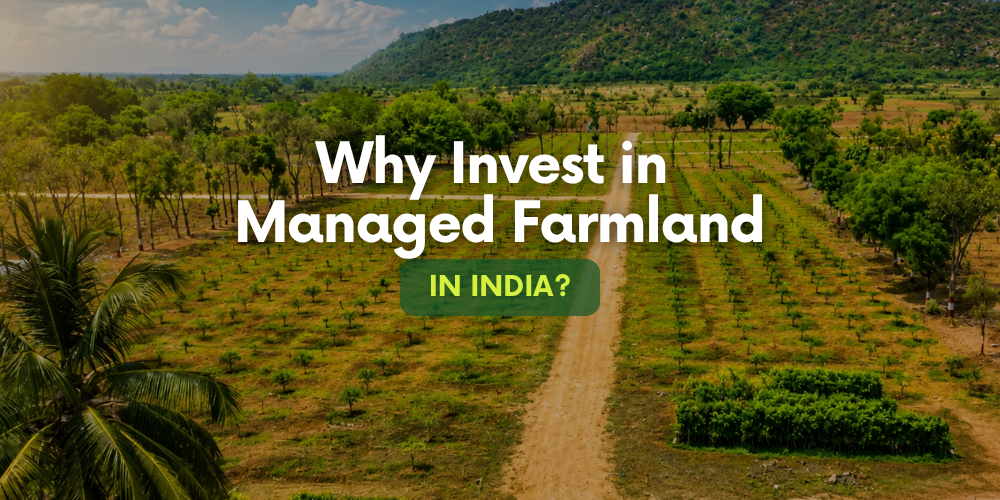
In the last few years, investment in managed farmlands in India has become quite popular. This is especially being noted among NRIs and urban investors. It is quickly becoming a preferred substitute for traditional real estate investments. This type of investment combines long-term asset security with emotional value, sustainability and income. With the country pushing towards sustainable agriculture, food security and eco-conscious development, there is promise of both purpose and profit with investments in managed farmlands. Find out why you should be interested in managed farmland investment in India.
What is Managed Farmland?
It is a type of agricultural land owned by investors but maintained and overseen professionally, by third-party service providers. In these specialized farms, the agricultural process is handled end-to-end, starting from the stage of soil preparation, selecting crops, planting irrigation and harvesting to sales of the crops.
As an investor, you do not need to get involved in the everyday operations of managing or operating your farmland. Nonetheless, you can enjoy the returns.
Key Benefits of Managed Farmland Investment in India

You can get the chance to generate passive income from your land. Unlike regular commercial or residential properties, where returns depend on economic cycles or availability of tenants, you can produce consistent yields from your farmlands every year, when you get it professionally managed.
Whether through lease arrangements, profit sharing with the management entity associated with the land or through direct crop sales, you can manage to earn stable returns every year. There is also steady value appreciation of your land, particularly if you purchase land in any of the fast-developing areas.
Managed farmlands also align with ESG (Environmental, Social, and Governance) investment goals. Such types of lands often focus on organic farming, reforestation, water conservation and biodiversity protection. As an investor, you can indirectly contribute to conserving the environment as well as sustainable food production and rural employment generation. You can also make an income alongside. Overall, with this type of an investment, you do not just own a land and make income from it; you can also own a sustainable future.
Managed Farmland vs. Direct Land Ownership vs. REITs
As compared to direct land ownership, you can get much more convenience with investments in managed farmlands. By making investments in a directly owned plot, you have to deal with finding reliable workers, arranging irrigation, managing seasonal activities and dealing with legal documentation.
With managed farmland investments, there is no such issue. You can get professionals to manage most of these responsibilities but you can get benefits for sure.
You can get full control with direct land ownership. However, it is time and effort-consuming and you also need experience. With Real Estate Investment Trusts (REITs), on the other hand, you can make an entry easily and there is also easy liquidity. But investors are not allowed to physically own or use the land in this case. These are purely financial instruments and volatility in the market can impact these a lot. With managed farmland, you can find a balance between the two extremes. You can manage to own the land, get it professionally managed, enjoy an optional rural lifestyle experience and also benefit from land value appreciation.
When it comes to the need for capital you often require less investment in case of managed farmland then urban land parcels. You can start with an investment of around ₹10–30 lakhs, But the land can be accessed by a wider range of investors. As compared to REITs, there is also deeper tangible and emotional value. You can get the satisfaction of being the owner of a vast piece of land that you can visit, grow crops in or develop as your second home - away from noisy urban areas.
Case Study — Managed Farmland Near Bangalore
The Bangalore region is one of the most active hubs when it comes to investing in managed farmland in India. You can experience a growing demand for sustainable living upcoming economic corridors and expanding infrastructure in and around Bangalore. Naturally there is an exception al growth in investment activities near Bangalore. There are online marketplaces where you can get access to some of the top managed firm projects in the area.
Navile Farms in Chikkaballapur is a notable example. Spread across 12 acres and divided into various-sized plots, this project offers investors the charm of fruit plantations, a clubhouse, a garden, and even drip irrigation and borewell water facilities. Prices here range between ₹43.5 lakh and ₹95.7 lakh, and the project is ideal for both nature-loving individuals and serious investors.

Another prominent name is Triguna Country Homes located in Denkanikottai. Spanning 100 acres, this farmland offers a 7-acre lake, custom-built farmhouses, and even a centuries-old banyan tree. With pricing between ₹49 lakh and ₹1.96 crore, it combines luxury and nature in perfect harmony.

Hasiru Chiguru Basavapura, another fully managed community, offers quarter- to half-acre plots in a 12-acre layout. It supports organic farming, electricity, and water services, starting from ₹30 lakh. This community-style setup promotes sustainable agriculture while allowing modern comforts.

These are just some of the managed farmland projects that you can find worth investing in. Spread over many miles, these verified farmlands in Bangalore are located in beautiful surroundings, have fertile soil to grow crops in and can absolutely be a pleasure to live in.
Conclusion: How to Get Started with Managed Farmland Investment in India
You need to have a clear objective of whether you are looking for long-term capital appreciation, a sustainable second home, making regular passive income or a mix of all, before you start your journey.
Once you have a proper idea, you can browse Farmlandbazaar to compare and verify properties based on amenities, location, budget and future prospects. You can physically inspect shortlisted properties, understand the seriousness of the projects and scope for development. Work with legal experts to ensure proper land titles that comply with local regulations. It is better to start with small investments and scale up once you understand the management model better.
Written by Farmland Bazaar Team
Agricultural assets advisor contributing to Farmland Bazaar v2. Focusing on organic investments, soil analysis reports, and deed checks.