
Your Farmland's Future: Grow Gold with Mahogany – Turn ₹200 into ₹1 Lakh!
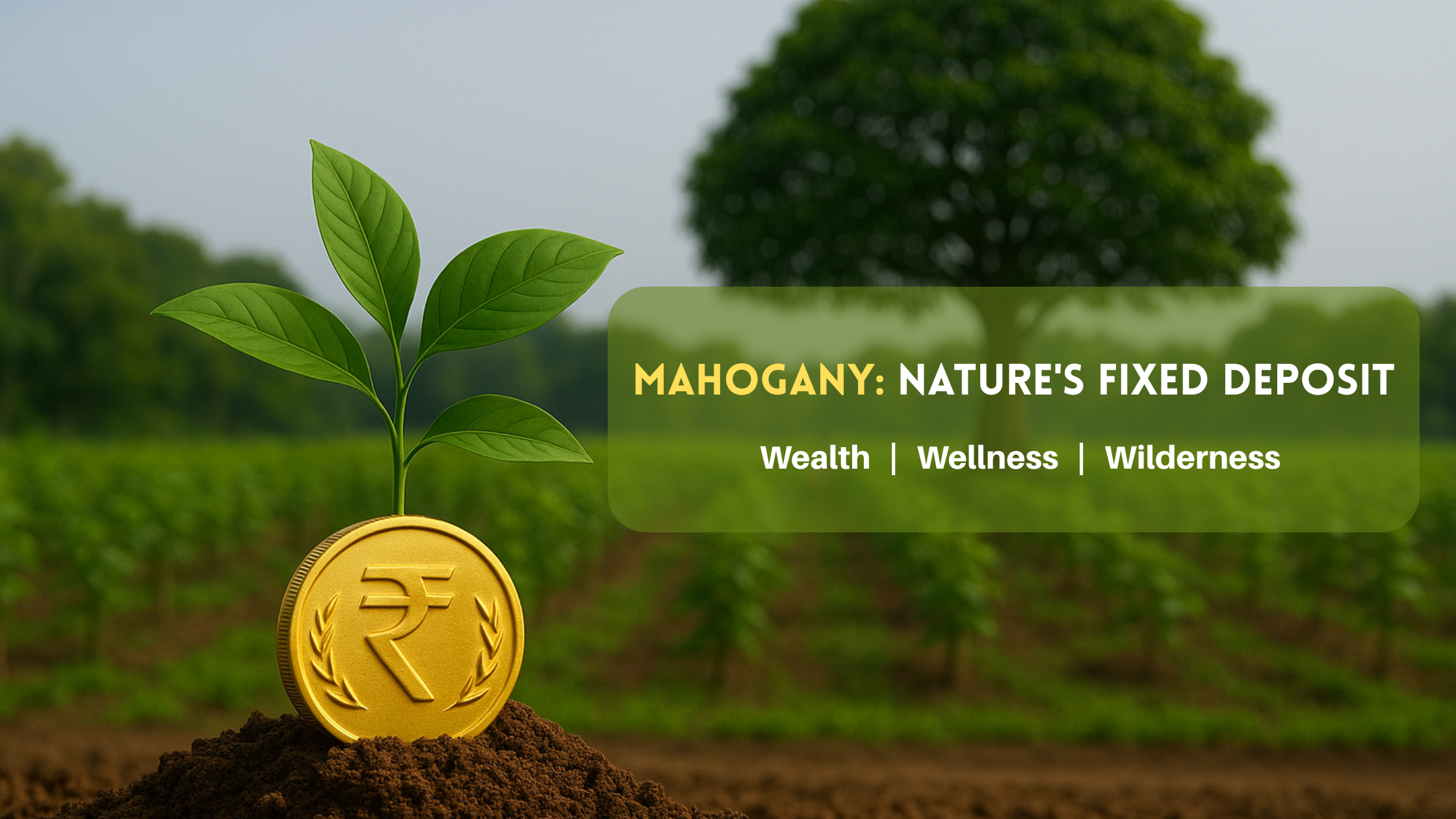
Are you a farmland or even farmhouse owner looking for an investment that truly grows? Imagine turning a small initial outlay into a substantial asset, securing your financial future for decades and for generations. While traditional crops offer seasonal returns, a silent revolution is brewing in sustainable agriculture: Mahogany tree farming.
Farmland Bazaar is here to help you unlock the hidden potential of your land. From Mahogany plantations to overall land appreciation — a living goldmine awaits, just a few years ahead.
Mahogany: The "Green Gold" Your Farm Deserves
Mahogany, scientifically known as Swietenia macrophylla, is not just a tree; it's a legacy. Renowned globally for its exceptionally high-quality timber, it boasts a rich reddish-brown hue, remarkable durability, and natural resistance to pests and water damage. These properties make it highly sought after in furniture making, luxury interiors, boat building and veneer production – ensuring a consistently high market demand.
Why Mahogany? Beyond financial gains, because it's much more than just being the Timber: Beyond its primary value as timber, mahogany trees contribute significantly to environmental and human well-being by improving soil health, aiding in carbon sequestration and supporting biodiversity.
Various parts of the mahogany tree, including its seeds, bark, and leaves, are used in traditional remedies for conditions like malaria, diabetes, and diarrhea. Its leaves are also used in manufacturing mosquito repellents, herbal tonics, and natural insecticides, adding to its commercial versatility.
Indian scientists have discovered that the big-leaf mahogany tree (Swietenia macrophylla) emits significant amounts of dimethyl sulfide (DMS), a sulfur compound that aids in cloud formation and helps reduce atmospheric warming caused by greenhouse gases. Your mahogany trees will literally help cool the planet!
This makes it not just a financial asset but also a responsible, healthy and sustainable choice for you and for your land.
The Power of Patience: How and Why Mahogany Delivers Unmatched Returns
Investing in mahogany is a long-term strategy, much like a robust fixed deposit that yields extraordinary returns upon maturity. The concept is simple: plant young mahogany saplings today, nurture them and watch their value appreciate exponentially over the next 10-15 years.
The "Why" of Unprecedented Financial Benefits
This is where mahogany truly shines for farmland owners. Consider this astounding potential:
Fact: According to a report in the Times of India, an initial investment of just ₹200 today in a mahogany sapling has the potential to grow into ₹1,00,000 (One Lakh Rupees) or more when the tree matures. Imagine multiplying this across acres of your farmland!
-
High Value Timber: Mahogany timber commands premium prices in national and international markets. A single mature tree can fetch a significant sum due to its quality and demand.
-
Long-Term Asset Creation: Unlike volatile stock markets, a mahogany plantation is a tangible asset that appreciates steadily. It's a generational investment, securing wealth for your family for decades to come.
-
Inflation Hedge: As global demand for quality timber rises and supply dwindles, the value of your mahogany trees is likely to outpace inflation.
-
Green Investment: Align with global sustainability trends. Your mahogany farm is a source of clean air and a testament to responsible land stewardship.
Well Just for a quick information, “More than 3.1 million mahogany trees have been planted across India by over 4,000 farmers as part of large-scale projects aimed at creating sustainable income sources and sequestering carbon. This highlights the growing acceptance and success of mahogany farming in the country”,which is quite commendable and obviously worth million.
The "How" of this amazing investment
-
Relatively Low Maintenance: Once established, mahogany trees require less intensive daily care compared to annual crops.
-
Climate Resilience: They are known to adapt well to various tropical and subtropical climates, making them suitable for many parts of India.
-
Sustainable Harvest: When mature, the timber can be selectively harvested, allowing for ongoing income streams.
Where to Plant: Mahogany thrives in well-drained loamy soils with good sunlight exposure. While adaptable, consistent moisture during the initial growth phases is beneficial. Ideal spacing for timber production typically ranges from 10x10 feet to 15x15 feet, allowing ample space for individual tree growth and maximizing timber yield per tree. You can plant them as boundary trees, intercrop them with certain annual crops or dedicate specific sections of your land.
Where to Source Saplings: It is crucial to source high-quality, disease-free saplings from reputable nurseries. Look for government-approved nurseries, agricultural universities or established private nurseries specializing in timber species. Always inquire about the species (ensure it's Swietenia macrophylla or a well-suited hybrid for your region) and cultivation advice they can provide. Many farmers have successfully sourced saplings online, making access easier than ever.
Think of your mahogany plantation as a "Living Fixed Deposit." Each tree planted today is an investment certificate that steadily gains value. It diversifies your farm's income streams, reduces reliance on single-crop cycles, and builds a powerful, long-term asset. While the initial investment might seem modest, the cumulative returns over 10-15 years can be truly transformative for your financial portfolio.
Don't let your farmland's potential lie dormant. Explore the incredible opportunity that mahogany tree farming presents. It's more than just agriculture; it's a strategic move towards a prosperous and sustainable future for you and generations to come.
Frequently Asked Questions (FAQs) for Farmland Owners:
Q1: What is the typical growth period for mahogany to reach harvestable size in India?
A1: While some sources might suggest shorter periods, for optimal timber quality and significant commercial value, mahogany trees typically require 15-20 years to reach full maturity in India. Some fast-growing varieties or ideal conditions might yield earlier, but patience ensures maximum returns.
Q2: Are there any government subsidies or schemes available for mahogany cultivation in India?
A2: Yes, the Indian government actively promotes agroforestry and tree plantation. Farmers engaged in such activities, including the cultivation of timber trees like mahogany, can often receive subsidies and technical support. It's advisable to check with your State Forest Department or local agricultural offices for specific schemes like the "National Bamboo Mission" or other state-specific agroforestry initiatives that may include support for mahogany. Some projects also facilitate farmers to earn income from carbon credits generated by their mahogany plantations.
Q3: What are the common pests and diseases affecting mahogany trees in India, and how can they be managed?
A3: Mahogany trees are generally robust, but like any crop, they can be susceptible to certain issues. Common concerns include:
-
Shoot borers (e.g., Hypsipyla robusta): These larvae bore into young shoots, causing damage.
-
Fungal diseases: Such as leaf spots or root rot in waterlogged conditions. Management typically involves using resistant varieties, good nursery practices, proper spacing for air circulation, and timely application of organic or approved biological pesticides/fungicides if an infestation is severe. Consulting local agricultural extension services is recommended for specific threats in your region.
Q4: What is the minimum land area required to start a profitable mahogany plantation?
A4: While the financial benefits are calculated per tree, for a truly "profitable" venture that provides substantial income, a minimum of 1 acre of dedicated land is often recommended. This allows for planting a significant number of trees (e.g., 300-400 trees per acre with optimal spacing), maximizing the eventual timber yield and, consequently, the financial return. Even smaller plots can be used for boundary plantations, providing supplementary income.
Citations:
-
The financial potential (₹200 to ₹1 Lakh) is referenced from an article in the Times of India titled "Turn Rs 200 into Rs 1 Lakh: Why Mahogany tree farming is India’s new green gold," dated June 15, 2022.
-
Facts on the number of trees planted in India are based on data from projects like "Mahogany Plantation in India Project (Verra Project 2479)," which reports over 3.1 million trees planted by 4,000+ farmers (Verra.org case studies).
-
Information on medicinal uses and DMS emission is based on scientific findings reported in various sources regarding Swietenia macrophylla.
-
Information for FAQs regarding government schemes, pests/diseases, and legal aspects is based on general knowledge of Indian agroforestry regulations and common challenges, corroborated by recent policy changes and project reports.
Read more: Why Are Managed Farmlands Gaining Popularity in India?
Written by Farmland Bazaar Team
Agricultural assets advisor contributing to Farmland Bazaar v2. Focusing on organic investments, soil analysis reports, and deed checks.