
Cauvery Calling: 13.4 Crores Trees Planted, Targets 1.2 Crore in 2026-27
The Cauvery River in Southern India is facing a massive ecological crisis. It has lost over 40% of its normal water flow because 87% of the original tree cover in the river basin has been cleared. To reverse this damage, the Save Soil - Cauvery Calling movement, launched by Sadhguru, is helping farmers shift from water-intensive traditional farming to sustainable agroforestry. This project turns environmental recovery into a profitable economic plan for rural communities, guided by Sadhguru's philosophy that "Cauvery has been the basin of human civilization in Southern India for thousands of years. Today, it is depleting rapidly because we have stripped the land of its cover. A forest-fed river cannot flow if there are no trees to hold the rain and feed the aquifers. If you restore the soil's organic matter through tree cover, the water will stay, the river will flow, and the farmer will thrive."
Core Project Targets and Achievements
The River Isn't Dying Because There's Less Rain
This is where Cauvery Calling challenges one of the biggest misconceptions about water. Most people believe rivers create water. Rivers do not create water. They depend on rainfall, groundwater recharge, and healthy landscapes to sustain flow throughout the year.
When rain falls on land with adequate tree cover, root systems help water infiltrate the soil, replenishing groundwater reserves. Organic matter in the soil acts like a sponge, holding moisture for longer periods and reducing runoff.
Where vegetation is sparse, a larger share of rainfall flows away quickly across the surface, increasing erosion and reducing the amount of water that enters the ground.
The principle behind Cauvery Calling is that restoring tree cover on agricultural land can improve soil health, strengthen groundwater recharge, and provide farmers with additional sources of income.

Cauvery Calling is built around a simple but powerful idea:
Restore the land, and the river can restore itself.
"The most important thing we can give to the next generation is a land that is rich and rivers that flow."
— Sadhguru
Agroforestry: The Core Strategy
Here is the thing
With Trees: Complex root systems act like a giant underground sponge. They absorb heavy rains, store the water in underground aquifers, and slowly weep it back into the river bed all year round.
Without Trees: Rainwater hits bare ground like concrete. It rushes over the surface instantly, causing devastating flash floods in the monsoon and severe water shortages in the summer.
The solution is Agroforestry: integrating high-value timber, fruit and fodder trees with existing crops. This creates multiple income streams while improving soil structure, biodiversity, and moisture retention. For many farmers, trees are viewed not only as an environmental asset but also as a long-term economic investment that can generate value over several years.
The Three Pillars: The Broader Save Soil System
Cauvery Calling is not operating as an isolated tree-planting drive. It is supported on the ground by two companion pillars under the global Save Soil umbrella. Together, these three initiatives tackle soil biology, education, and market economics simultaneously.
Pillar 1: Cauvery Calling (The Agroforestry Engine)
Focuses on the logistics, nursery infrastructure, and sapling deployment required to bring tree cover back to private farmlands.
Pillar 2: Save Soil Regenerative Revolution (SS-RR)
The scientific training arm of the movement. SS-RR teaches low-tillage, mulching, and cover cropping methods that restore soil organic carbon. As of March 31, 2026, SS-RR has conducted 532 intensive training programs, guiding 40,311 farmers into regenerative agriculture. It has also generated over 296 million views across 1,260 technical video guides on YouTube.
Pillar 3: Save Soil Farmers Movement
The macroeconomic anchor. This initiative organizes independent smallholders into Farmer Producer Organisations (FPOs). By aggregating their produce, small farmers gain corporate bargaining power to access major timber, fruit, and carbon-credit markets directly, bypassing exploitative middlemen.
Building the Infrastructure
Large-scale agroforestry requires more than planting campaigns. It depends on nursery capacity, distribution networks, and farmer support systems.
The initiative's infrastructure includes:
A major nursery in Cuddalore with an annual capacity of 85 lakh saplings
A second nursery in Tiruvannamalai producing 15 lakh saplings
A network of distribution centres serving farmers across Tamil Nadu and Karnataka
Access to more than 50 varieties of timber, fruit, flower, and fodder trees suited to local conditions
The nurseries are designed to supply planting material at subsidized rates, making agroforestry more accessible to small and medium farmers.
A Model Built on Public Participation
One of the distinctive aspects of Cauvery Calling is its public sponsorship model.
Individuals, institutions, and businesses can contribute towards sapling production and distribution. According to the programme, a contribution of ₹42 sponsors one tree, helping cover nursery operations, logistics, and delivery to participating farmers.
Looking Ahead
River restoration is a long-term process measured not in seasons but in decades. Whether large-scale agroforestry can transform the ecological trajectory of the Cauvery basin will ultimately depend on tree survival, farmer participation and sustained adoption across the landscape.
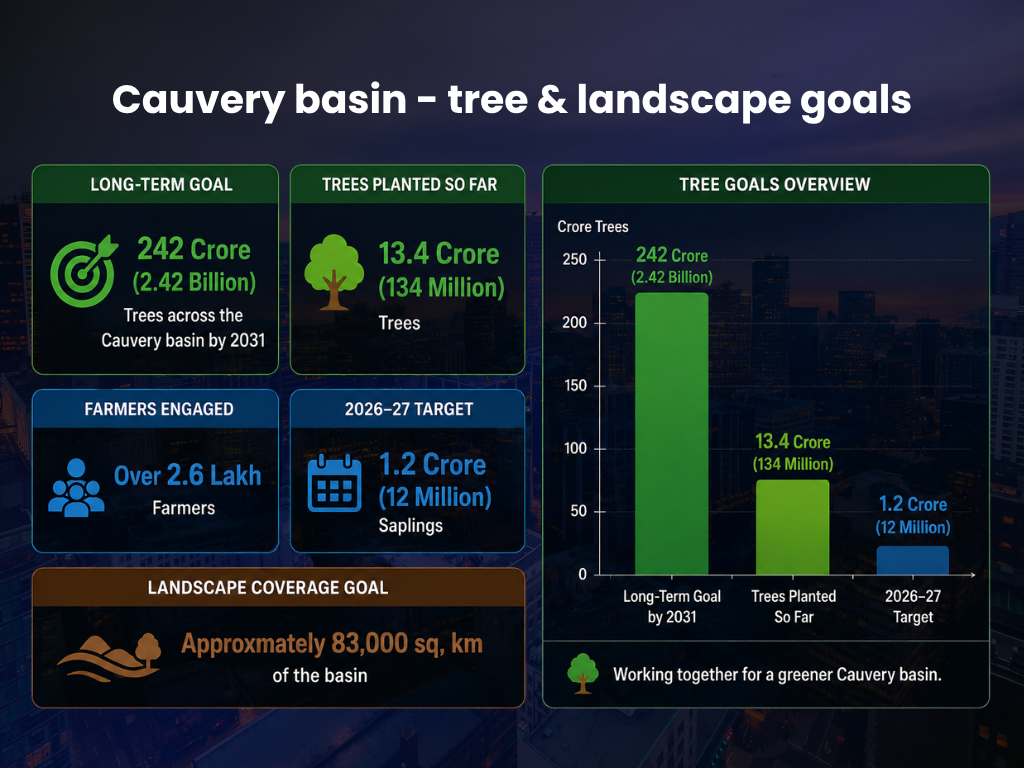
What is already evident, however, is the scale of the experiment. With 13.4 crore trees planted, over 2.6 lakh farmers engaged, and a target of 242 crore trees, Cauvery Calling has become one of the world's largest farmer-led agroforestry programmes, an effort that seeks to align ecological recovery with rural prosperity.
At Farmland Bazaar, we believe that the future of land ownership must go beyond investment and embrace stewardship. Initiatives such as Cauvery Calling demonstrate how restoring tree cover, improving soil health, and supporting farming communities can create lasting value for both people and the planet. As advocates of sustainable land use, we support efforts that help regenerate ecosystems, strengthen rural livelihoods, and preserve nature for future generations.
Written by Farmland Bazaar Team
Agricultural assets advisor contributing to Farmland Bazaar v2. Focusing on organic investments, soil analysis reports, and deed checks.