
From Fallen Coconut Leaves to ₹70 Lakhs: What Every Farmland Investor Can Learn from This Professor's Story
What if the next big opportunity in rural India isn't hidden under the soil, but lying on the ground?
Every year, millions of coconut leaves fall naturally across farms in southern India. Most are burned, discarded, or left to rot. To most people, they're a waste. To one English professor from Bengaluru, they became the foundation of a business that reportedly grew into a multi-lakh enterprise.
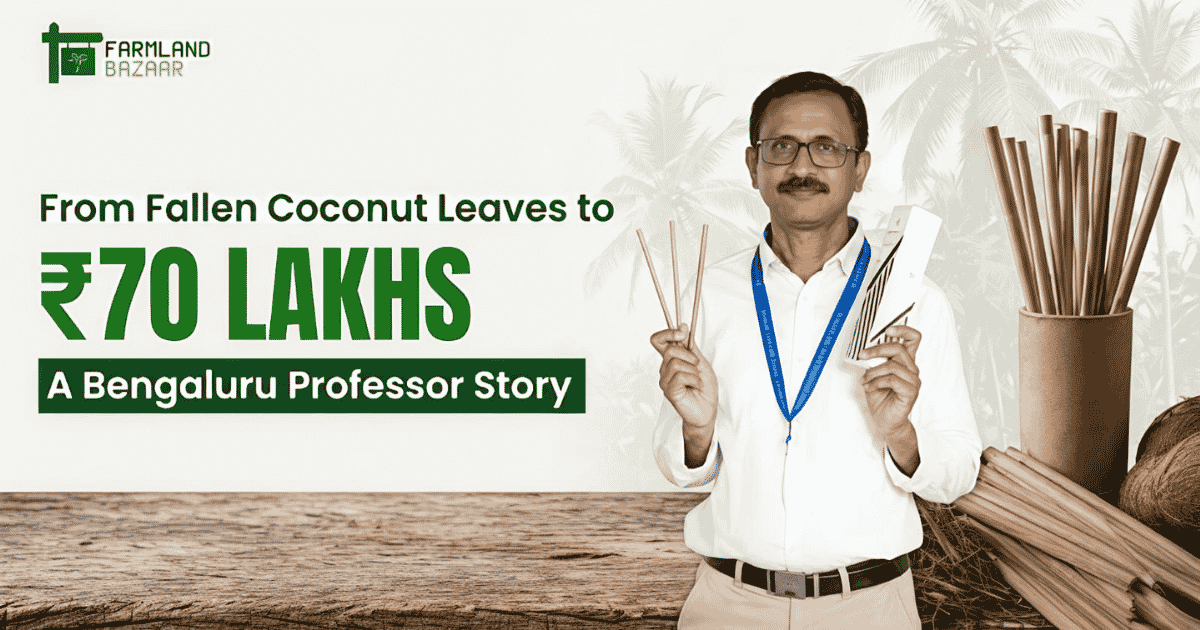
That's the story of Dr. Saji Varghese, founder of Sunbird Straws and it's not really a startup story. It's a reminder for every farmland investor: land doesn't only make money by going up in price. It makes money because of what happens on it.
The Walk That Changed Everything
Dr. Varghese wasn't an engineer, an industrial designer or a manufacturer. He taught English.
On a walk, he noticed the natural tubular shape of a dried coconut leaf and started wondering if it could be turned into a drinking straw. Years of trial and error later, Sunbird Straws launched in 2020: made from naturally fallen leaves, no trees cut, no plastic, fully biodegradable.
Nobody handed him a blueprint. He looked at something farmers step over every day and asked a different question than everyone else was asking.
Land Pays in More Than One Currency
Most people buy farmland expecting exactly one thing: the price goes up over time. That's real, but it's the smallest part of the story if you only look at that.
The same acre can pay you through the produce it grows, through the fruits, vegetables, spices, plantation crops. It can pay through the waste it sheds like leaves, husk, branches, biomass that someone, somewhere, will pay to turn into something useful. It can pay through the people who want to visit it via different models like farm stays, weekend retreats, second-home living. It can pay through what it protects including trees, biodiversity, the kind of long-term environmental value that's only going to matter more. And increasingly, it can pay through the small businesses it makes possible like processing units, craft ventures, eco-product lines run by people who never thought of themselves as entrepreneurs until the land gave them a reason to.
Sunbird Straws sits right at the crossing point of the second and fifth: waste nobody wanted, turned into a business nobody expected.
The Shift India Hasn't Caught Up To Yet
India produces enormous volumes of agricultural residue every year, and a large share of it just sits there, unused. At the same time, the world's appetite for alternatives to single-use plastic keeps growing. Hotels, airlines, cafés and food brands are all hunting for exactly this kind of material.
Put those two facts next to each other and you get a fairly simple equation: farm waste, run through simple processing, becomes an eco-friendly product that a premium market is actively looking for. Farmland stops being just a production asset. It starts looking like a raw-material platform for the next generation of green businesses.
A Lesson Bigger Than the Number
Whether Sunbird Straws is worth ₹70 lakhs, a crore, or something else entirely isn't really the point. The point is that someone with zero manufacturing background built value out of something farmers routinely burn.
That's not a one-off. Coconut husk became coir. Banana fibre became textiles and handicrafts. Areca leaves became plates and packaging. Mango seed kernels became cosmetic and food ingredients. Farm prunings became biochar and compost. Every one of these started the same way Dr. Varghese did with someone deciding that waste was just a name nobody had gotten around to changing yet.
The opportunity isn't always growing. Sometimes it's in wasting less.
What This Should Change About How You Look at a Plot
Before you evaluate a farmland project on location and appreciation alone, it's worth asking what's actually growing there naturally, what gets discarded from it every season, and whether there's a market or processor anywhere nearby that would want it. It's worth asking whether the land could support something smaller and more personal too, such as a nursery, a café, a farm stay. The kind of lifestyle business that pays every month instead of only once, at resale. And it's worth asking the longer question: will this land still matter in ten years, or does its value begin and end with speculation? Land with water, trees, and a real use case tends to age a lot better than land that was only ever a bet on a number going up.
Farmland Investors Are Changing, Not Just Farmland
A new kind of buyer is showing up in this market, and they're not buying only to farm. They're buying for weekend living, for their kids to grow up near something green, for long-term wealth that doesn't evaporate, for income that doesn't depend on a single harvest, and for the simple satisfaction of putting land to better use than it was before. That's exactly why hospitality-led managed farmlands and regenerative farming communities near Bengaluru, Hyderabad and Pune are pulling in so much attention right now.
The question buyers are asking has quietly changed. It used to be "how much will this land appreciate?" Increasingly, it's "what kind of life and legacy can this land actually create?"
The change of Perspectives
The most inspiring part of Dr. Saji Varghese's story isn't the straw. It's the perspective.
He looked at a fallen coconut leaf and saw the possibility where everyone else saw litter. Farmland rewards the same instinct. One investor sees an empty plot. Another sees a forest, a weekend home, a farm stay, a brand, a community or a small business quietly turning what the land throws away into what it's remembered for.
The biggest winners in rural India over the next decade may not be the people who simply own the most land. They may be the ones who noticed the value already flowing through it.
And sometimes, that value starts with something as ordinary as a dry leaf under your feet. Don't just invest in acres. Invest in ecosystems, ideas, and income opportunities that grow with time because the future of farmland isn't only about cultivation. It's about creation.
Written by Farmland Bazaar Team
Agricultural assets advisor contributing to Farmland Bazaar v2. Focusing on organic investments, soil analysis reports, and deed checks.