
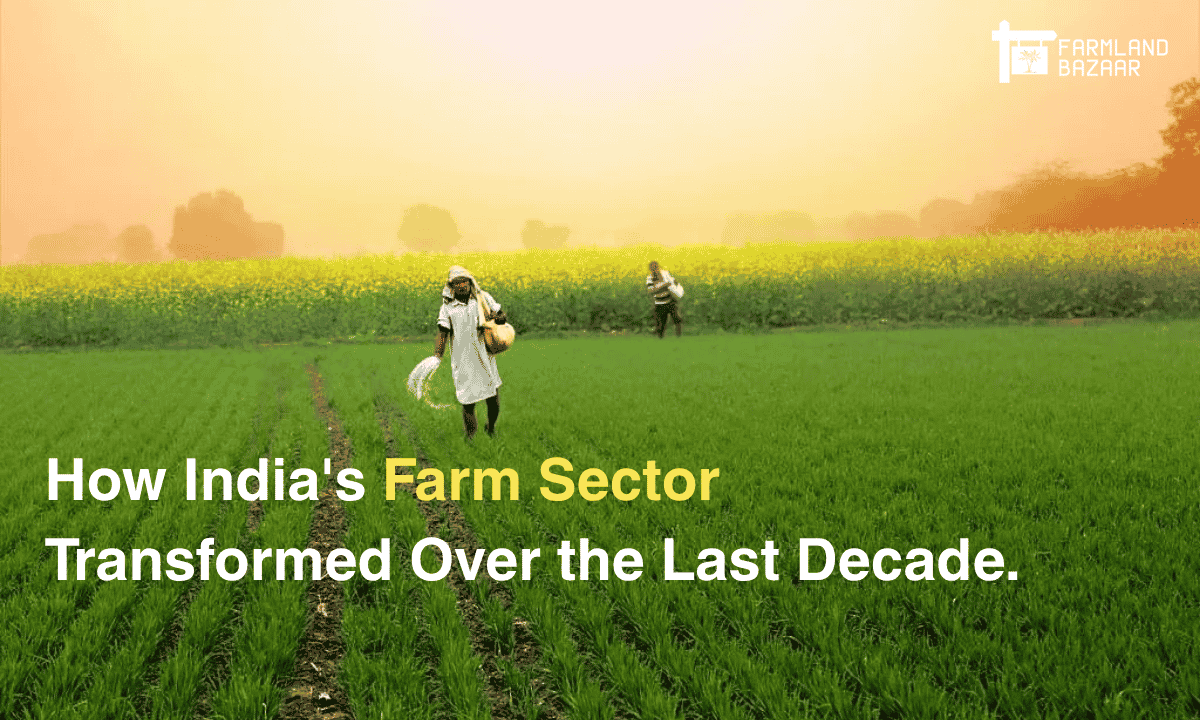
How India's Farm Sector Transformed Over the Last Decade
Ten years ago, if you told an urban professional in Bengaluru or Pune that buying a farm plot was a smart financial decision, they would have smiled politely and changed the subject. Farming was something that happened in the background of India's growth story. Was it essential? Yes, but not aspirational. Not investable. Certainly not a lifestyle.
That conversation has changed entirely.
Indian agriculture in 2025 looks fundamentally different from what it was in 2015; not just in the crops it grows or the technology it uses, but in who is participating, how land is being valued and what a farm can mean for someone who has never held a plough.
The Agriculture Economy: Bigger, Deeper, More Productive
Start with the headline number. Agriculture's Gross Value Added has more than doubled from Rs 20.9 lakh crore in 2014-15 to Rs 48.7 lakh crore in 2023-24, a compound annual growth rate of 8.83 per cent. That is not a marginal improvement. That is a structural shift in the economic weight of a sector that was long assumed to be stagnant.
Foodgrain production tells the same story. India achieved its highest-ever output of 357.73 million tonnes in 2024-25, nearly 8 per cent higher than the previous year. Agricultural exports touched an all-time high of approximately US$ 53 billion in FY25, driven by growing global demand for Indian commodities. The sector grew 5.4 per cent year-on-year in FY25 alone.
What drove this? A combination of forces that rarely get credit together.
-
Irrigation coverage expanded from 49.3 per cent in 2015-16 to 55 per cent of gross cropped area by 2020-21. Institutional credit deepened.
-
The PM-KISAN scheme delivered direct income support to over 110 million farmer families. MSP procurement operations expanded across crops, giving farmers more predictable price floors in volatile seasons.
-
The allied sectors outpaced even this impressive core growth. Fisheries expanded at 13.67 per cent annually. Livestock grew at 12.99 per cent. Milk production rose 63.56 per cent over the decade, from 146.3 million tonnes in 2014-15 to 239.2 million tonnes in 2023-24. India now accounts for 25 per cent of global milk output and has held the top position since 1998.
The foundation is stronger. The numbers confirm it. But the more interesting story is what has been built on top of that foundation.
The Rise of Managed Farmland and Farm Stays
Perhaps the most unexpected development in India's agricultural evolution has been the emergence of managed farmland and farm stays as a distinct and fast-growing category; one that sits at the intersection of real estate investment, lifestyle aspiration and agricultural productivity.
For most of India's history, farmland ownership was confined to those who actually farmed it. Urban professionals had neither the knowledge nor the time to manage agricultural land, and the idea of buying a farm plot as a financial asset barely existed as a formal category.
That changed decisively over the past five years, particularly, post COVID
The model is straightforward but powerful; agricultural land that is legally owned by an individual but cultivated and operated by a professional farm management company. The landowner holds the asset and receives a share of produce value or rental income, while the management company handles soil preparation, planting, irrigation, harvesting and market linkages. No farming experience required. No daily involvement needed.
Managed farmland models have also opened up the investor base dramatically, offering fractional ownership, smaller plot sizes and customised plans that have made farmland accessible to salaried professionals, couples and first-time investors who would never have considered agricultural land before. Land values near expanding urban centres in Karnataka, Tamil Nadu and Maharashtra have appreciated at 6 to 15 per cent annually in recent years, with peri-urban corridors around Bengaluru recording 10 to 14 per cent CAGR according to Knight Frank's 2024 data.
India's organic farming market, a significant driver of managed farmland value, is projected to reach Rs 70,000 crore, powered by rising urban demand for chemical-free, traceable produce. Managed farmland projects operating on organic principles sit directly in the path of this demand.
Alongside managed farmland, agritourism and farm stays have emerged as a genuinely new category of India's rural economy. The India agritourism market was valued at USD 1,388.74 million in 2025 and is projected to grow at a compound annual growth rate of 17.18 per cent through 2034. As per IMARC, more than 62 per cent of agritourism bookings now happen online, reflecting a new, digitally confident buyer who treats a farm stay with the same intent as a holiday or wellness retreat booking.
For the farmland investor, this matters directly. A well-located, well-managed farm plot today can generate income not just from produce but from hospitality, positioning land as a multi-stream asset rather than a single-purpose holding.
Moreover, Agricultural income in India remains tax-exempt under Section 10(1) of the Income Tax Act. Combined with land appreciation, produce income and agritourism potential, the investment case for managed farmland has moved from niche to mainstream.
Carbon Farming -The Revenue Stream Nobody Saw Coming
If managed farmland was the first surprise of the decade, carbon farming may be the defining story of the next one.
Carbon farming refers to agricultural practices specifically designed to sequester carbon dioxide from the atmosphere into soil and biomass. Farmers who adopt practices like conservation tillage, cover cropping etc can generate carbon credits, which are traded in voluntary or compliance carbon markets and represent an entirely new revenue stream that requires no additional produce, no new markets and no significant capital investment.
The growth of this category in India has been sharp. Agriculture carbon credits saw a 283 per cent increase in transaction volume between 2021 and 2022 alone. India now has over 50 active agricultural carbon credit projects targeting 16.5 million hectares. The voluntary carbon market in India was valued at over Rs 10,201 crore, with agriculture emerging as one of the highest-value credit categories. The India low carbon farming market is expected to grow from USD 50.26 million in 2024 to USD 190.47 million by 2035, a CAGR of 12.88 per cent.
For the managed farmland investor, the implications are direct. A plot managed with agroforestry, organic practices or reduced-tillage methods is not just producing food, it is potentially generating carbon credits that add an entirely new income layer. Agroforestry in particular blends conventional cropping with timber and fruit tree plantations, delivering income from multiple sources while building long-term soil health and carbon sequestration value.
New Farming Methods
The tools available to an Indian farmer in 2025 bear almost no resemblance to what was available a decade ago. Precision agriculture, the use of GPS mapping, IoT sensors, drones, satellite imagery and AI-driven analytics to optimize inputs at the field level, has moved from pilot programmes to mainstream adoption across progressive farming communities.
The India precision agriculture market reached USD 304.60 million in 2024 and is projected to reach USD 700.87 million by 2033 at a CAGR of 9.70 per cent. The Indian government invested Rs 6,000 crore in 2024 alone to promote precision farming using artificial intelligence, drones and data analytics. By 2025, over 60 per cent of Indian farms are expected to have adopted some form of precision agriculture technique.
What does this mean practically? Farmers can now monitor soil moisture, nutrient levels and crop health remotely.Natural farming and regenerative agriculture have also gained significant policy momentum. The Soil Health Card scheme, integrated nutrient management programmes and government promotion of zero-budget natural farming across several states have begun to shift the conversation from yield maximisation to soil health as a long-term value driver.
For the managed farmland sector specifically, technology adoption is a differentiator. Projects that offer buyers real-time dashboards, satellite monitoring updates and transparent produce tracking are commanding premium valuations because they answer the urban investor's central anxiety: how do I know what is happening on my land?
More Inclusive Than Ever
The profile of who participates in Indian agriculture has changed meaningfully over this decade and that too in ways that matter both socially and economically.
At the farmer level, digital inclusion has accelerated sharply. Mobile-based advisory platforms, weather forecasting apps, e-NAM digital marketplace access and direct benefit transfer systems have begun to bridge the information gap between small and marginal farmers and the tools that larger farmers have always had access to.
Women's participation has grown across farm operations, though carbon farming research reveals that the sector still has significant ground to cover, with only 4 per cent of carbon farming programme participants being women in surveyed projects in Haryana and Madhya Pradesh.
At the investor level, the doors have genuinely opened. Managed farmland developers now offer plots starting at sizes and price points accessible to salaried professionals who were entirely absent from agricultural land markets a decade ago. Buyers seeking a tangible connection to Indian land, young professionals pursuing lifestyle diversification and sustainability-motivated investors looking for ESG-aligned assets have all entered the farmland market in ways that were structurally impossible before managed farmland models created the right entry point.
Multiple Revenue Streams
Perhaps the most important shift in how sophisticated farmland investors now think about agricultural land is the move from single-stream to multi-stream income thinking. A well-managed farm plot near an Indian growth corridor in 2025 can generate value across several channels simultaneously:
Produce income: From the direct agricultural output of the land, whether that is fruits, vegetables, timber, floriculture or specialty crops. Indian agricultural land investment returns are expected to range between 9 and 14 per cent annually in 2025, according to Farmonaut's investment analysis.
Land appreciation: Driven by infrastructure expansion, urban growth and the increasing scarcity of well-located, well-managed farmland; agricultural corridors near Bengaluru have consistently delivered 10 to 14 per cent capital appreciation.
Agritourism and farm stay income: As the agritourism market grows at 17 per cent annually, well-positioned farm properties with hospitality infrastructure can generate meaningful rental yield from weekend visitors, corporate wellness retreats and experiential travel seekers.
Carbon credits: From regenerative practices, agroforestry and organic farming methods that sequester carbon and generate tradable credits in a market growing at over 12 per cent CAGR.
Government scheme benefits: Schemes including subsidies under PM-KISAN, the Pradhan Mantri Krishi Sinchai Yojana for irrigation, and 100 per cent FDI-eligible contract farming structures that open additional capital and market linkage pathways.
Tax efficiency underpins all of this: Agricultural income in India remains exempt from income tax, making the effective return on a well-managed farm plot meaningfully higher than an equivalent return from most other asset classes.
The Field Has Changed. The Opportunity Is Now.
Over the last ten years, Indian agriculture has changed in ways few people could have imagined. What was once seen mainly as a traditional occupation is now becoming a modern, technology-driven and investment-friendly sector. Better infrastructure, improved farming methods, managed farmland projects, agritourism and carbon farming have created new opportunities for both farmers and investors. Today, farmland is no longer valued only for what it grows, but also for its potential to generate multiple income streams and long-term wealth. As the sector continues to evolve, agriculture is set to play an even bigger role in India's economic and sustainable growth story.
Written by Farmland Bazaar Team
Agricultural assets advisor contributing to Farmland Bazaar v2. Focusing on organic investments, soil analysis reports, and deed checks.