
The Rise of Managed Farmland as India’s Next Big Investment Frontier
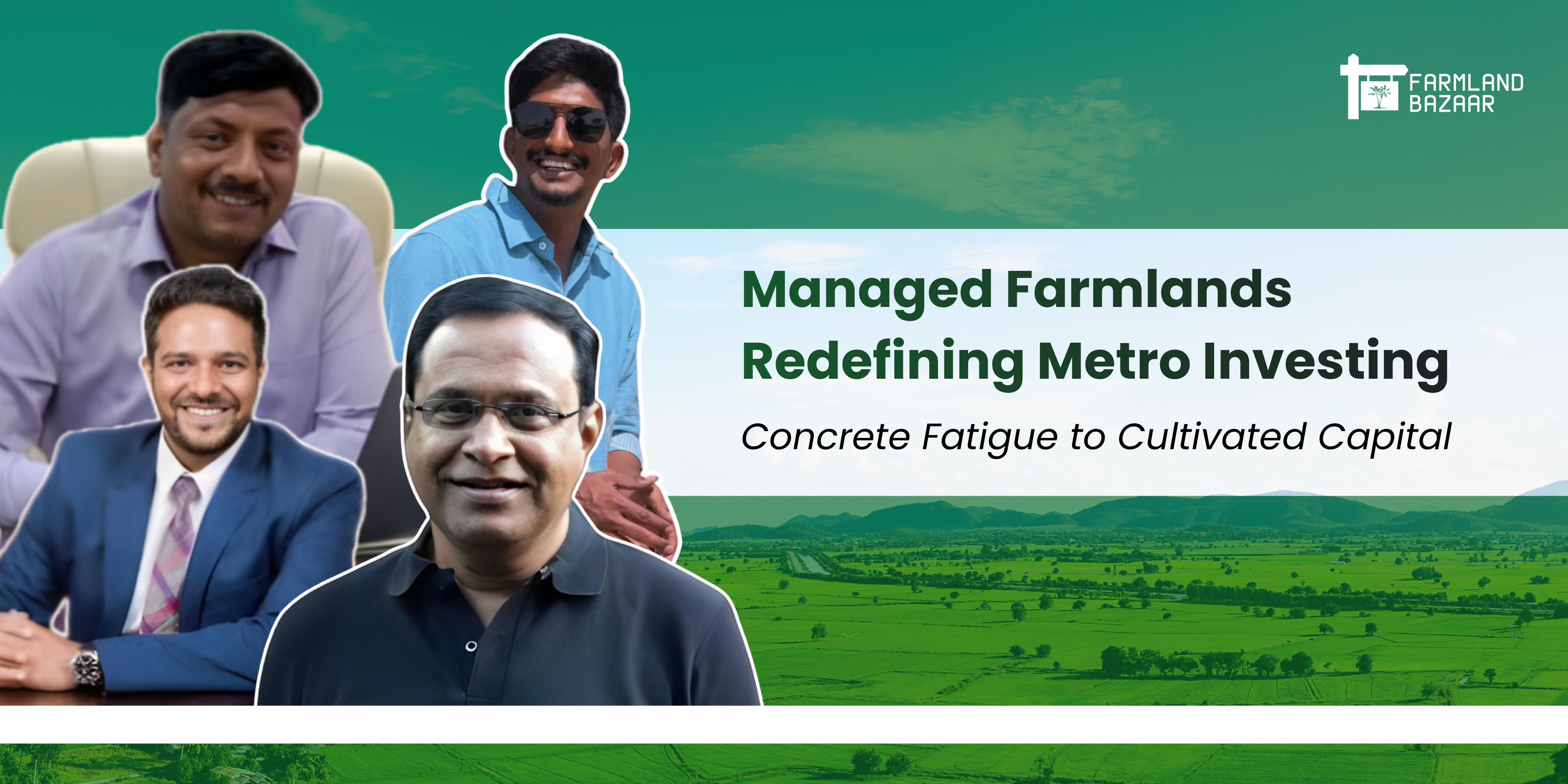
The traditional view of Indian real estate is undergoing a fundamental shift. For decades, city investors were locked into the residential-commercial cycle, while farmland was seen as a legacy asset for rural communities. But today, managed farmland has moved from a weekend hobby to a strategic financial asset that balances aggressive growth with long-term security. The numbers tell a compelling story: in 2024, the Indian agricultural market was valued at $372.94 billion, with projections for 2026 reaching approximately $917.91 billion. This massive jump is driven by government initiatives and digital farming tech, proving that for the urban professional, this isn't just about buying dirt, it’s about owning a slice of a high-performing industry.
FarmlandBazaar spoke with leading developers and experts of managed farmland communities to understand how this transformation unfolded and where the industry is heading.
The Post-Pandemic Behavioral Correction
The pandemic was a major wake-up call for people living in big cities. It wasn't just about health; it was a complete lifestyle reset. After being stuck in crowded high-rise apartments for months, many urban families realized that having a small balcony wasn't enough. The dream of owning land moved to a strategic necessity.
Today, people are looking for a Plan B. They want low-density spaces where they can breathe, connect with nature, and own a tangible asset that isn't just a number on a screen. This has created a new group of buyers: tech founders, NRIs and young professionals who want to balance their city life with a productive piece of land just a few hours away.
As Amit Porwal, Director Aranyakaa Farms explains:

“Before 2020, managed farmland was almost non-existent in serious investor conversations. Enquiries were sporadic and largely curiosity-driven. Post-Covid, we saw a dramatic shift. Urban families who experienced confinement began actively looking for access to open land within a few hours of the city. The intent changed from ‘interesting idea’ to ‘strategic consideration.’ What we are witnessing today is not a temporary spike; it is a behavioural correction in how people perceive space, health, and long-term security.”
This behavioral correction means people now see land as more than just property. It’s an investment in their health, family legacy and long-term financial security.
The Wealth Creation Engine: Returns Beyond the Concrete
The math of managed farmland is simple: unlike apartments, which structurally depreciate and require constant maintenance, land is a non-depreciating asset that improves with care. While city rental yields often hover around 2–3%, the capital appreciation of well-located farmland is significantly higher.
Specific projects are proving that unbelievable returns are now the reality. For instance, Triguna Country Homes, a 100-acre managed community near Bangalore, has seen returns as high as 200% since 2020. This massive jump is driven by a combination of infrastructure growth such as the upcoming Hosur Airport just 10km away. This momentum isn't isolated; Aranyakaa Farms reported a 75% appreciation in land value across its projects within just three years, while belts like Chikkaballapur and Kanakapura have seen regional price spikes of 20–30% as demand outpaces supply.
Professionalizing the Field
The shift toward managed farmland in India is more than just a trend; it is the professionalization of an entire asset class. For decades, city investors stayed away from agricultural land because of the operational headache, the fear of encroachment, the struggle of finding labor and the lack of technical farming knowledge.
Today, this barrier is being dismantled by a new breed of developers who treat farms like high-tech manufacturing units. Leading the charge are firms like Hosachiguru, which has successfully brought over 1,500 co-farmers into its fold, managing more than 1,500 acres of high-yield timber and fruit orchards. By applying data-driven monitoring and scientific plantation methods, they have turned fragmented plots into institutional-grade estates.
Pawan Gupta, Founder, Farmlandbazaar, explains the transition:

“From what we see on our platform, buyers today don’t just want land, they want clarity and confidence. The biggest concern has always been: ‘What happens after I buy?’ ‘Who will take care of operations, harvesting, and soil health?’ That’s exactly why managed farmland is gaining traction. Buyers prefer projects where irrigation, maintenance and planning are already taken care of. It removes uncertainty and makes farmland more than just a hobby to a strategic land investment with minimal hassle in maintenance.”
By removing the need for direct farming expertise, these models allow investors to participate in high-yield agriculture, such as Sandalwood or Mahogany, which provide huge returns in over 10 to 15 years.
The Sustainability Premium: More Than Just "Green" Looks
In the past, many farm projects only cared about "cosmetic landscaping." Developers would plant a few pretty flowers at the gate and call it a farm. Today, that has changed. Modern managed farmland uses Agroforestry, which means planting different layers of trees and crops together. Instead of just one type of tree, you have tall timber trees, fruit trees, and smaller plants all growing in one spot. They protect each other, just like a natural forest.
This shift is a stability strategy. Developers now focus on soil regeneration making the dirt healthier every year instead of wearing it out with chemicals. Think of healthy soil like a savings account; the better the soil, the more your land is worth later. By adding water harvesting and planting native trees that don't need much water, these farms are built to survive droughts.
As the Bheemesh Reddy, Chairman and MD of Sungraze Group of companies explains:

“We are moving beyond cosmetic landscaping. Agroforestry, water harvesting systems, soil regeneration and native species plantation are becoming central to project design. Sustainable farming practices are not just environmentally responsible; they enhance land productivity and long-term stability. Buyers are increasingly asking about water tables, soil testing and plantation cycles,the conversations that were rare a few years ago.”
Governance as the New Foundation
As the sector matures, investors are demanding institutional-level transparency. Clear titles, zoning compliance, and defined management agreements are now the minimum requirement for growth.
As Mr. Mithun, Founder Neralu Farms, highlights:

“The sector cannot grow on aspiration alone. Governance is everything. Clear titles, zoning compliance, irrigation planning, plantation schedules and defined management agreements are essential. Today’s buyer is far more informed and cautious. If developers do not prioritise transparency and operational accountability, the category will struggle to gain institutional trust. Professionalisation is not optional; it is the foundation of sustainable growth in managed farmland.”
Farmland as a Long-Term Wealth Strategy
One of the biggest differences between city real estate and managed farmland is how they age. Think about a typical apartment: the moment it's built, the structure starts to wear out. Elevators need replacing, walls need repainting, and after 20 years, the building often loses its premium feel. This is called structural depreciation. To keep an apartment valuable, you have to keep spending money on it.
Managed farmland works in the exact opposite way. When you take care of the land, it actually gets younger and more productive. Through soil enrichment, the land becomes more fertile every year. As the trees on your farm reach plantation maturity, they don't just sit there; they grow into high-value timber or fruit-bearing assets. While an apartment gets older, your farm is busy growing your net worth.
This makes farmland the perfect slow and steady asset for families. It acts as a hedge against inflation and provides a solid foundation for intergenerational wealth.
Manjunath, Founder at Kimberly Properties, explains this perfectly:

“Apartments depreciate structurally over time and require periodic capital infusion. Agricultural land, when responsibly managed, can improve in quality through soil enrichment and plantation maturity. Many of our investors are thinking in 15-20 year horizons. They see managed farmland as a tangible, low-leverage asset that balances their urban portfolios and aligns with intergenerational wealth planning.”
Conclusion
What began as a lifestyle choice has blossomed into a sophisticated investment theme. With the rise of digital marketplaces like FarmlandBazaar, the traditional barriers of opacity and lack of verification are vanishing. Managed farmland now represents a rare triple-win for investors: it offers tax-free agricultural income (under Section 10(1)), significant capital appreciation, and a meaningful contribution to environmental sustainability.
That said, the sector is still evolving. Regulatory clarity differs across states, land aggregation takes time and professional farm management remains critical. There is also a risk of over-commercialisation if growth is not balanced with ecological responsibility.
Despite these challenges, the fundamentals remain strong:
-
Post-COVID shift in lifestyle priorities
-
Rising urban density and shrinking green spaces
-
Infrastructure expansion around metro regions
-
Growing focus on sustainability-led investing
-
Increasing demand for tangible, finite assets
As cities continue to expand, managed farmland is not an escape from urban living but a smart extension of it. With the right focus on governance and transparency, it has the potential to become a recognised part of mainstream real estate portfolios.
Written by Farmland Bazaar Team
Agricultural assets advisor contributing to Farmland Bazaar v2. Focusing on organic investments, soil analysis reports, and deed checks.